A parkour roll takes you diagonally across your back, from one shoulder to the opposite hip, so the force of a landing turns into forward movement instead of going straight into your legs. Start crouched on grass, hands flat on the ground, chin tucked, and roll over your lead shoulder to the opposite hip, keeping your head and spine off the ground. Then build up from crouching, to standing, to jumping and finally to small drops.
Why the Roll Matters
The roll is how traceurs take bigger drops without taking the full impact through their knees. A study in the Journal of Sports Science and Medicine measured traceurs dropping from 0.75 m and found the roll cut peak landing force by 43% and the loading rate by 63% compared with a traditional landing. As Breaking Muscle’s guide to rolling puts it, an efficient roll translates your momentum forward, and good rolling technique is also the best way to recover from an unplanned fall.
How to Do a Parkour Roll, Step by Step
- Start in a low squat on grass or a mat. Decide which shoulder you’ll roll over. You’ll train both sides eventually.
- Place your hands flat on the ground. London Parkour teaches hands flat at about 45 degrees to your body. Breaking Muscle teaches a diamond shape with the palms flat. Both spread the load before your shoulder makes contact.
- Tuck your chin. Danish parkour team JIYO says to keep your chin against your chest all the way round, which protects your head.
- Roll from your lead shoulder to the opposite hip. Drop your forward shoulder to the ground and let your body travel diagonally across your back. London Parkour is clear that your head and knees must not touch the ground.
- Come up moving. Let the momentum carry you over your hip and back onto your feet, ready to keep running.
The Progression: Crouch to Drop
- Crouch roll. From a low squat, as above, until it feels smooth on both sides.
- Standing roll. Breaking Muscle’s next step is taking the roll from a standing position, with a little more speed.
- Jump roll. A small jump forward into the roll, so you learn to roll out of momentum.
- Drop roll. London Parkour’s drop roll tutorial suggests starting from a low wall and dropping straight into the roll. Their advice is not to land first, take the impact and then roll, but to flow straight into it.
- Hard ground. Move to concrete only once the roll is smooth on soft ground. London Parkour says being able to roll on concrete matters in the end, because that’s where real drops land, so build up to it from grass.
Common Mistakes
- Rolling straight over your head. A gymnastics forward roll exposes your head, neck and spine to the ground. London Parkour rules out sideways and gymnastics rolls entirely.
- Hitting your spine. JIYO warns that you can accidentally hit the spine, which hurts. That’s a sign your path isn’t diagonal enough.
- Landing on bony points. Breaking Muscle lists the top of the shoulder, the ridge of the shoulder blade, the hip bone, elbows, knees and heels as the places to avoid.
- Rolling onto your knees. London Parkour’s standard is to come up onto your feet without your knees touching the ground.
- Landing, then rolling. On drops, a pause between the landing and the roll means you’ve already taken the impact. London Parkour’s advice is to flow straight into it.
When to Roll and When to Just Land
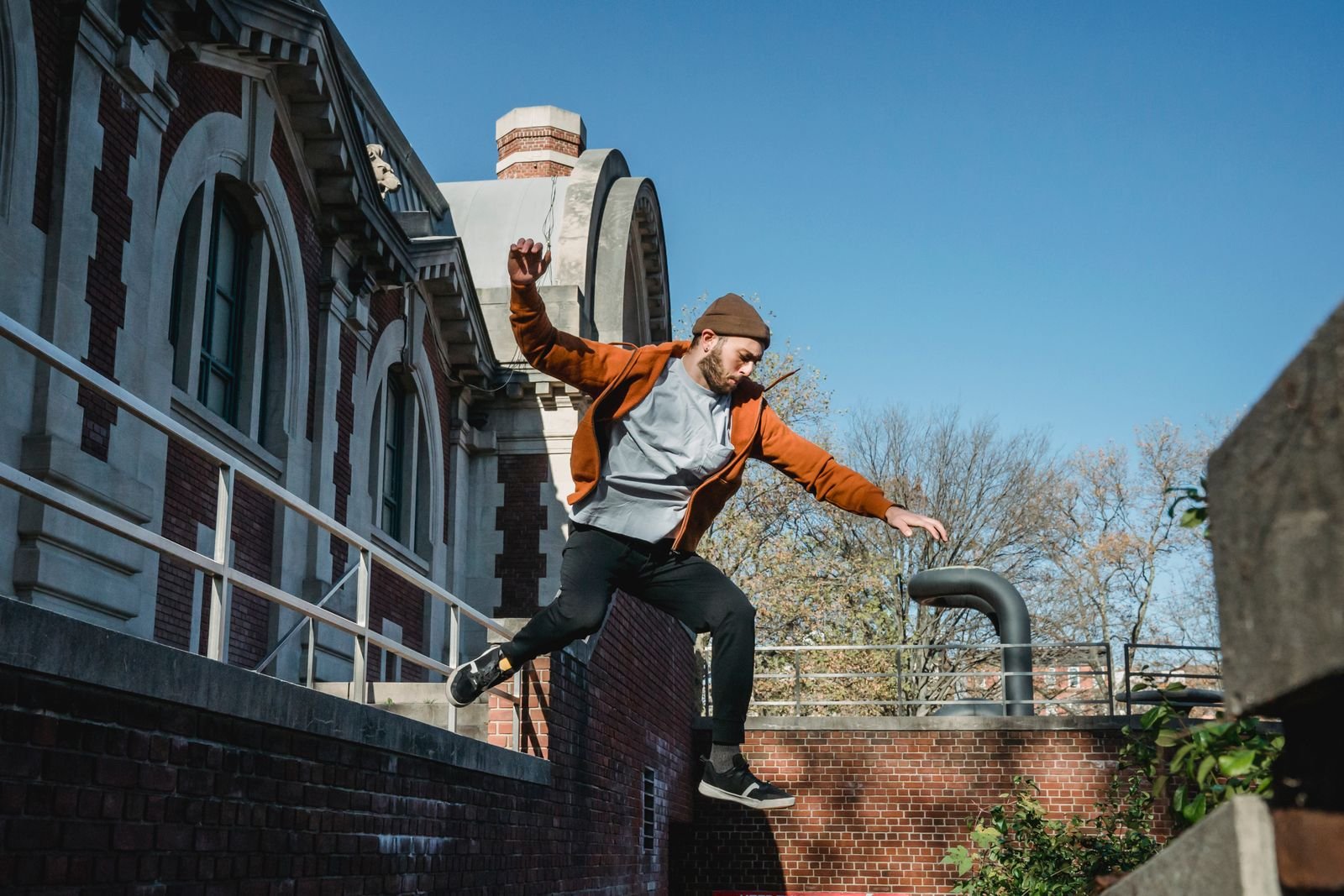
For small drops, a quiet precision landing on the balls of your feet is enough. As drops get bigger, Breaking Muscle recommends rolling to limit the impact through your knees. The full height progression is in Landing Progressions: From Flat Ground to Height.
Frequently Asked Questions
Which shoulder should I roll over?
Start with whichever feels natural, then train the other side too. London Parkour’s own standard is three good rolls over each shoulder, because in real movement you won’t always get to choose.
Does a parkour roll hurt on concrete?
A good one shouldn’t, but early attempts can leave you sore. That’s why every progression starts on grass or a mat and only moves to concrete once the roll is smooth.
Is a parkour roll the same as a forward roll?
No. A gymnastics forward roll goes straight over your head and down your spine. A parkour roll goes diagonally from one shoulder to the opposite hip, which keeps your head and spine off hard ground.
Where to Go Next
Landing and rolling are the second stage of our 30-Day Beginner Parkour Training Routine. For the other half of safe landings, read How to Build Ankle Strength for Safer Landings.
Pingback: 30-Day Beginner Parkour Training Routine (Safe Home Plan)
Pingback: Parkour Landing Progressions: From Flat Ground To Height