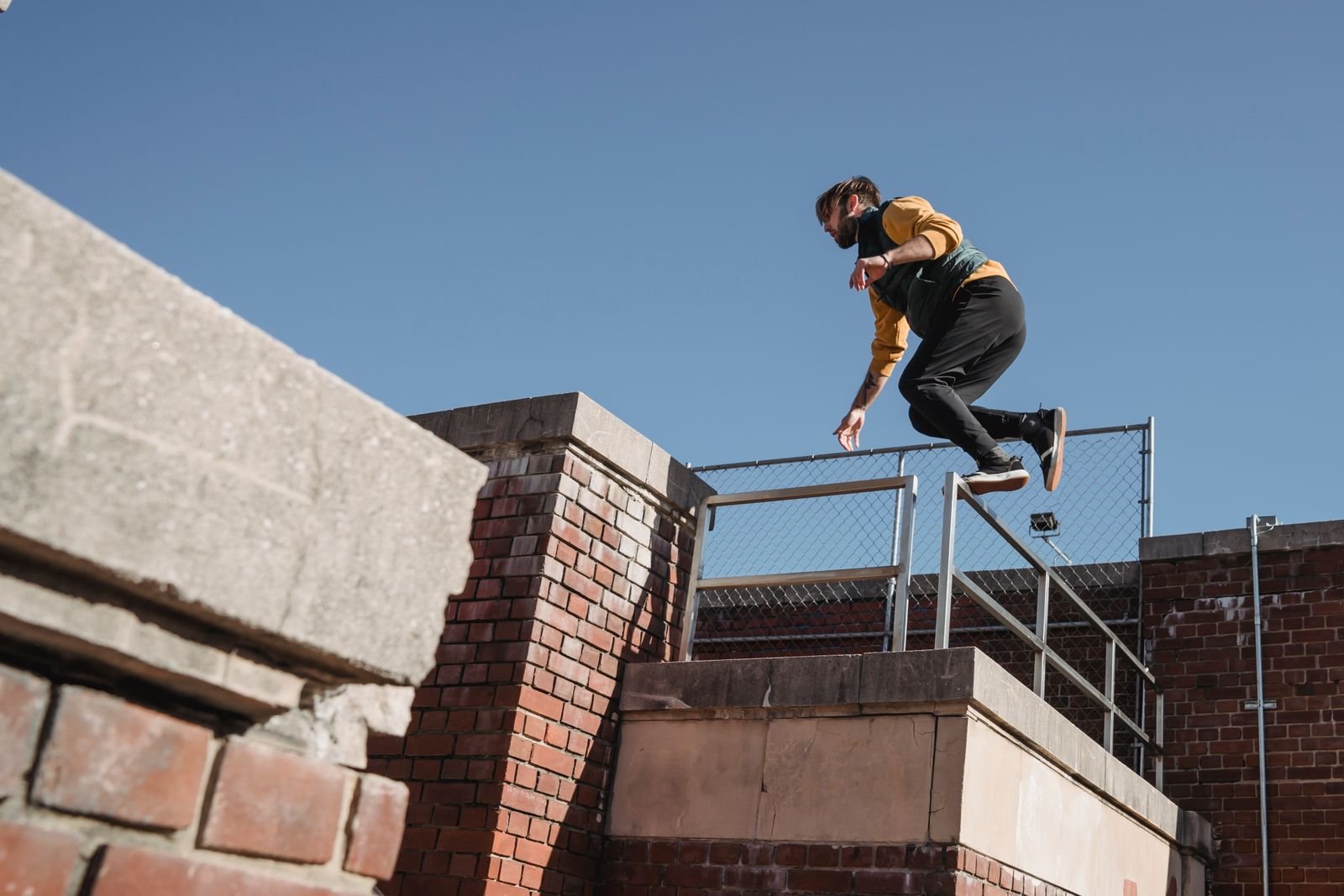
A rail precision is a precision jump that lands on top of a rail. You land with the rail across the balls of both feet, feet close together, heels up and knees bent, and grip the rail with your feet to stop dead. It’s one of the hardest precision jumps, so build it from the ground up: line jumps first, then wide low targets, then a low rail, and only add distance or height once your landings are consistently clean.
Why Rail Precisions Are So Hard
A London Parkour coach describes the rail precision as the pinnacle of precision jumping, in the transcript of its landing accuracy lesson. On a flat target you have room to adjust. On a rail you have a few centimetres, and any leftover momentum tips you off. Breaking Muscle’s precision guide also treats railing jumps as advanced.
Make sure your standing precision jump is solid on flat targets first, and that you’re comfortable balancing on a rail with rail and ledge walking.
How to Land on a Rail
- Pick an exact point on the rail. Look at where you want your feet, not at the rail in general.
- Jump with a slight arc. As in a standing precision, an arc gives you more control on the way down than a flat, low jump.
- Land on the balls of your feet. London Parkour’s lesson describes rail landings as landing just on the balls of the feet and gripping the rail.
- Keep your feet close together and centred. Rockstar Academy recommends feet close together for stability, and warns that landing off-centre hurts your balance.
- Heels up, knees bent. London Parkour’s lesson notes say to keep your heel raised and your knees bent as you land. On a rail only your forefoot is on the surface, so this is different from a normal flat landing.
- Kill the momentum and hold. Rockstar Academy suggests bending your knees and bringing your arms slightly forward after landing to cancel leftover momentum before you move on.
Progressions
- Line jumps on the ground. Breaking Muscle and Rockstar Academy both start with a line on the ground as the target, such as the painted lines of a court or car park.
- Wide, low targets. Curbs and low walls. Rockstar Academy suggests starting on a wider surface and narrowing it as your control improves.
- Precision trainers at home. Breaking Muscle suggests practising rail jumps low to the ground with precision trainers. American Parkour sells a steel Rail Precision Trainer for this.
- A low rail at short distance. Start with jumps that feel almost too easy, from 60 to 80% of your maximum standing jump, as Rockstar Academy recommends for precision training in general.
- Different rails. London Parkour’s lesson suggests practising on different surfaces, including round rails, to build adaptability.
- More distance, then height. One variable at a time, and only once landings are quiet and consistent.
How to Fail Safely
Missing a rail is part of learning it. Rockstar Academy recommends practising your bail-outs: if you undershoot, land short and bounce back, and if you overshoot, roll forward to release the momentum. Our guide to the parkour roll covers that last part. Keep rails low until bailing out is automatic, and check the rail is solid, dry and free of dust first.
Frequently Asked Questions
Should my feet land across the rail or along it?
For a rail precision, across it, with the rail under the balls of your feet. Walking along a rail is different: there, the foot runs parallel to the rail, as covered in Rail and Ledge Walking.
What shoes are best for rail precisions?
Shoes with a flat, grippy rubber sole. Parkour UK recommends flat, one-piece rubber soles for grip and advises against rigid soles that curve up strongly at the heel or toe. See our guide to parkour shoes.
Can I do a running rail precision?
Eventually, but it’s much harder, because you have more momentum to stop on a tiny surface. Master standing rail precisions first, then work through Strides and Running Precisions on flat targets.
Where to Go Next
Train balance on rails with Parkour Cat Balance, and strengthen your landings with How to Build Ankle Strength for Safer Landings.