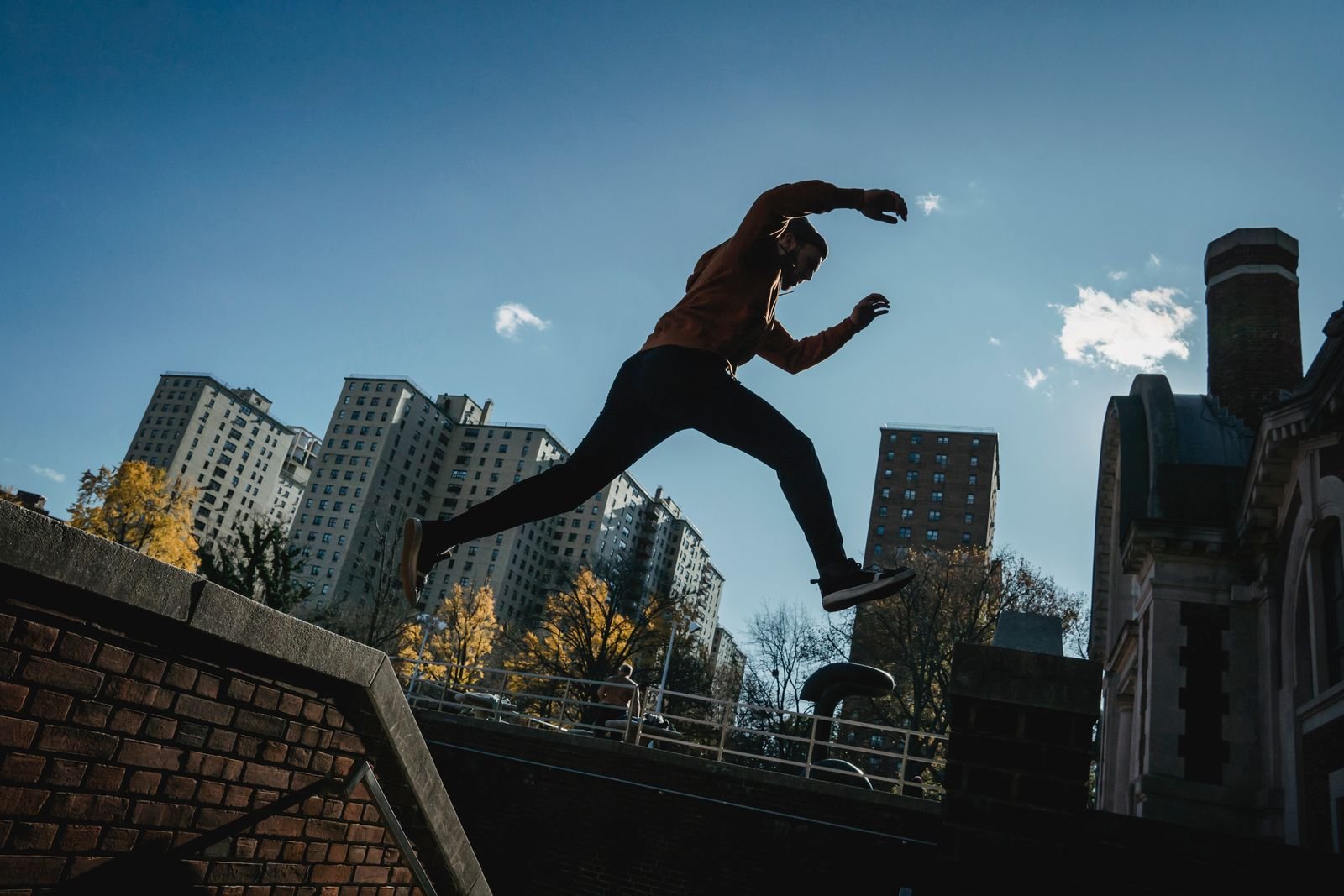
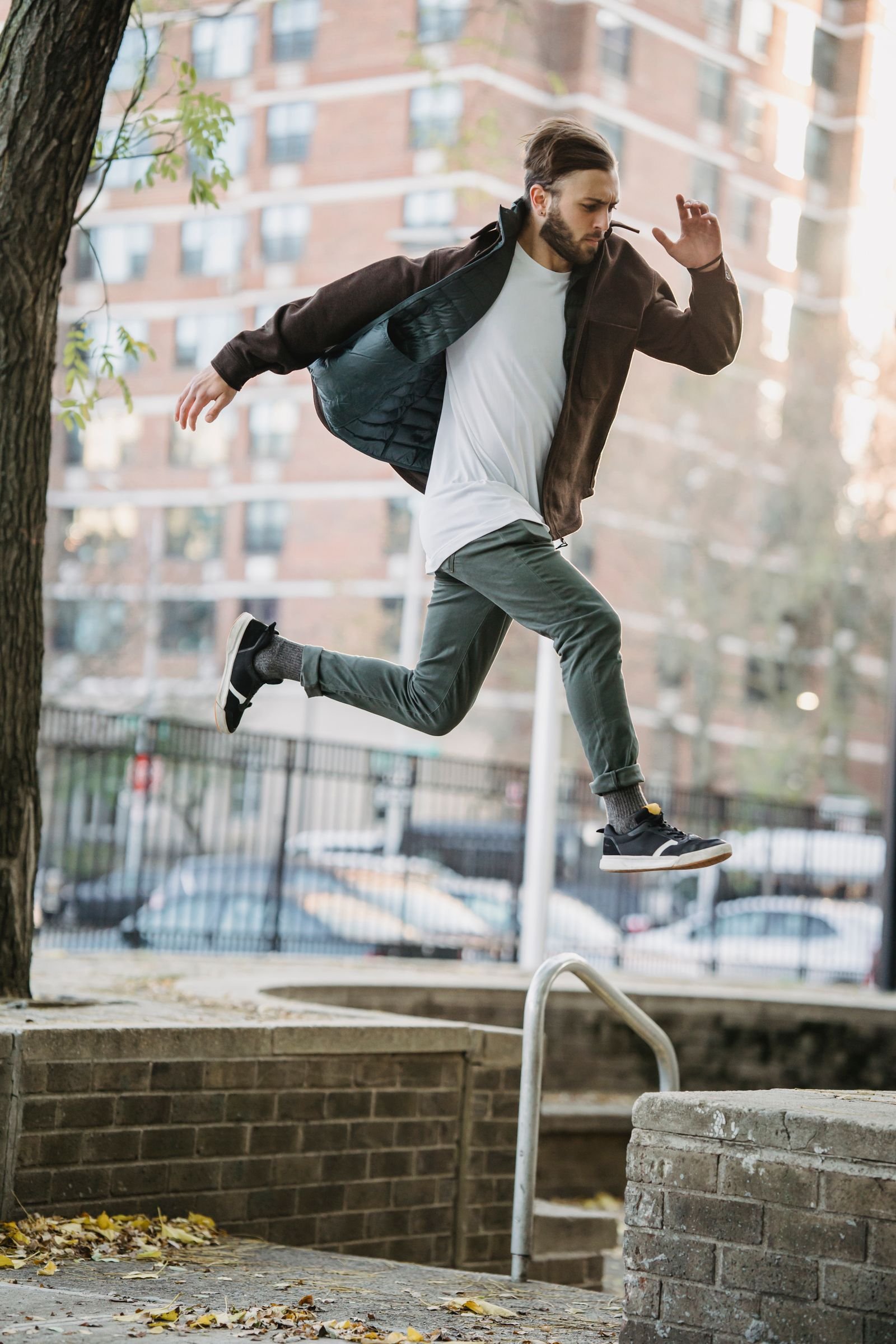
Strides are running bounds from one foot to the other across a series of obstacles, touching each one with a single foot. A running precision is a jump taken from a run, off one foot, that lands on both feet on a target and stops. Start both on flat ground with painted lines as targets, learn to land quietly on the balls of your feet, and only then move to curbs, low walls and longer gaps.
Strides vs. Running Precisions
Both start from a run and take off from one foot. The difference is the landing. A stride lands on the other foot and keeps going, like an exaggerated running step. A running precision lands on both feet and sticks, with no extra step. Our guide to the standing precision jump covers the two-footed take-off version, and its landing skills carry straight over.
Start on Flat Ground
Breaking Muscle’s precision guide starts with a painted line on a court or car park as the target. Land on the balls of your feet without letting your heels slap down, as quietly as you can, and move further back only once your landings are controlled. Master landings on the ground before you jump to targets at any height.
How to Do Strides
- Run in to a mark. In Breaking Muscle’s stride drill, you run up to a starting mark, then bound from one leg to the other.
- Spend as little time on the ground as possible. Spring forward quickly, reach through with your free leg and pump your arms hard. Their image for it: treat the floor like a hot stovetop.
- Be light and quiet. Breaking Muscle’s cue is to make as little sound as you can.
- Aim for fewer steps. The drill’s goal is covering a set distance in as few bounds as possible.
Once flat-ground bounds feel smooth, move to obstacles. Mobilesport.ch, the Swiss Federal Office of Sport’s training resource (the linked page is in Italian), uses a strides game where you touch each element with only one foot, plant that foot in the centre of the element, and use your arms for momentum. The gaps should suit your level.
How to Do a Running Precision
- Pick your launch spot. Breaking Muscle’s advice for one-foot take-offs is to choose a fixed spot on the ground as your launch mark.
- Pick an exact target. A specific point, not a general area, just as with a standing precision.
- Take off from one foot at the mark, reaching through your toes towards the target.
- Land on the balls of both feet. On small targets, bring your feet close together.
- Absorb and stick. Bend more at the knees and hips to soak up the landing, and hold it. Breaking Muscle notes that getting low also helps if you start to fall.
The running take-off adds forward speed you have to stop on landing, which is why a running precision is harder to stick than a standing one at the same distance. Start short.
Drills and Progressions
- The 3-second stick. The Swiss manual’s “Game of Stick” only counts a landing that’s held for three seconds. American Parkour’s precision drills use the same three-second hold.
- The 6 out of 10 rule. American Parkour’s progression is to step back a few inches only once you stick 6 of 10 landings at your current distance, and to move closer again if you miss twice.
- Weaker foot only. The Swiss manual suggests taking off only from your weaker foot as a harder variant.
- Fewest strides. Cover a set distance in as few strides as you can.
- Vary the targets. Breaking Muscle suggests curbs, stair edges and low pipes once ground landings are solid.
Safety Checks
- Check every surface. The Swiss manual says to clear dirt from landing surfaces and make sure they aren’t slippery. Our guide to which surfaces you can trust explains why.
- One change at a time. Add distance or height, never both at once.
- Stop when landings get loud. Noisy landings are a sign of fatigue.
Frequently Asked Questions
Which foot should I take off from?
Whichever feels natural at first. Then train the other one, since the Swiss manual uses weaker-foot take-offs as a progression, and real spots won’t always suit your favourite foot.
Are strides the same as bounding?
They’re very similar. Breaking Muscle describes the stride drill as bounding from one leg to the other. In parkour, strides usually go between obstacles rather than along flat ground.
Why do I keep overshooting running precisions?
Too much run-up speed for the distance. Shorten your approach, jump up as well as forward, and absorb more through your knees and hips.
Where to Go Next
Build the power behind longer strides with Plyometrics for Parkour, and make landings stronger with How to Build Ankle Strength for Safer Landings.