Running builds a real aerobic base, but it trains only one kind of fitness: steady, repetitive, lower-body-dominant endurance. Parkour demands something different, explosive bursts, upper-body and core endurance, and the ability to recover quickly between short, intense efforts. Running alone leaves real gaps that show up exactly when you need capacity most, mid-session, several vaults in, when fatigue starts affecting your form.

Parkour Is Interval Training, Not Steady-State
The stop-start nature of running, jumping, and climbing during a real session is naturally a form of high-intensity interval training, short explosive bursts followed by brief recovery, repeated. Steady-state running trains a completely different energy system than this. Research comparing interval training against steady-state exercise confirms these really are distinct physiological pathways, not just different paces of the same thing. You can be a genuinely strong distance runner and still gas out fast during a parkour session, because your body was never trained to recover quickly between short, maximal efforts.
Running Neglects Upper Body and Core
Running primarily works your legs while doing very little for your upper body or core, exactly the areas parkour leans on constantly for vaults, climbs, and landings. Relying on running alone risks a real muscle imbalance over time, which shows up as poor posture, joint strain, and a higher injury risk, not just weaker arms.
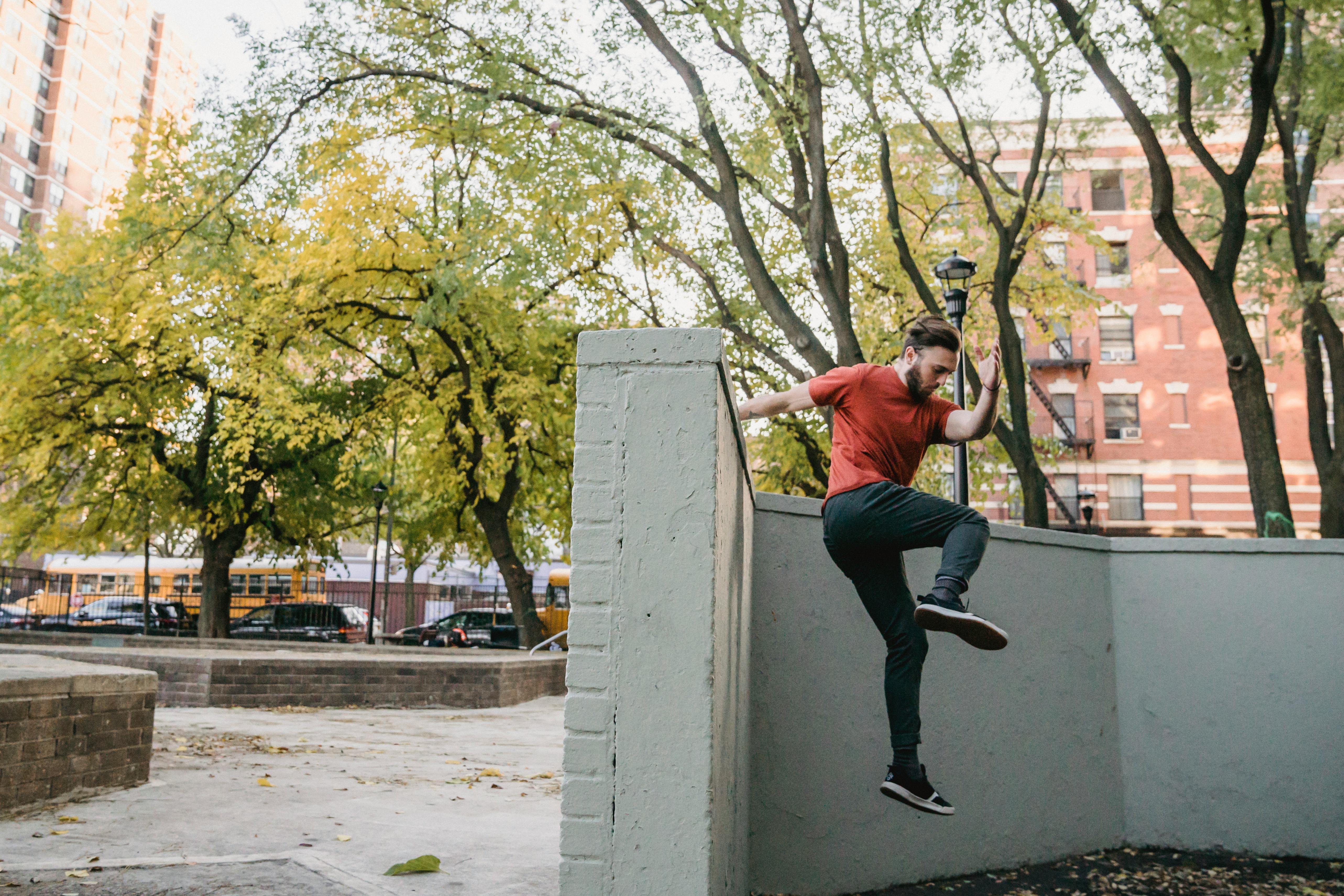
What to Add Alongside Running
Bear crawling for distance, or while pulling light resistance, is a genuinely underrated conditioning tool: it’s a contralateral movement that builds hand-eye coordination, core strength, grip, and balance simultaneously, none of which running touches. Sprint intervals (short, maximal bursts with full recovery between) train the specific energy system parkour actually uses, closer to real training demands than a steady jog. Crawling along a narrow beam or curb adds a body-awareness challenge on top of the conditioning benefit.
Where Running Still Genuinely Helps
This isn’t an argument to drop running entirely. Regular running improves your aerobic base while also reinforcing hip stabilization and core strength over distance, and it sharpens your ability to judge speed and distance through moving visual reference points, a real, transferable skill for reading a line before you commit to it. Trail running specifically adds unpredictable footing, which builds ankle and hip stability in a way flat pavement running doesn’t.
A Balanced Weekly Approach
- 1-2x per week: Steady running (builds aerobic base, ideally on trail or varied terrain)
- 1x per week: Sprint intervals (short maximal efforts, full recovery between)
- 1-2x per week: Bear crawls or crawling variations for distance
- Ongoing: Regular parkour training itself, which naturally reinforces interval-style conditioning
Frequently Asked Questions
Should I stop running if I want to improve at parkour?
No. Running still builds a real aerobic base and reinforces useful skills like distance judgment. The fix isn’t dropping running, it’s adding interval work, upper-body conditioning, and crawling variations alongside it.
How much running is actually useful for parkour?
One to two sessions a week is a reasonable amount for most traceurs, enough to maintain a real aerobic base without crowding out the sprint, crawling, and strength work that more directly transfers to parkour movement.
Is sprinting better than jogging for parkour fitness?
Sprinting trains the explosive, interval-style energy system parkour actually uses during a session, which jogging doesn’t. Both have a place, but sprint work is the closer match to real parkour demands.
Where to Go Next
Conditioning pairs directly with home-based strength work. Read next: 5 Parkour Conditioning Exercises You Can Do at Home and Does Weight Training Actually Help Parkour?.