A precision jump is a controlled standing jump from one exact point to another, landing on the balls of your feet with zero extra momentum carrying you forward. No running start, no margin for a sloppy landing, just a clean launch and a controlled stick. It’s one of the most fundamental skills in parkour, and one of the easiest to train safely at low height before you ever need it for something real.

What Makes a Precision Jump Different
Unlike a running jump, a precision starts and ends completely stationary, no leftover momentum should push you off your landing point. Published biomechanics research analyzing precision jump technique confirms what experienced traceurs already know by feel: landing happens on the forefoot without heel contact, and your central nervous system actively coordinates dozens of joint and muscle interactions simultaneously to keep that landing stable. This isn’t a simple jump, it’s a genuinely complex coordinated skill, which is exactly why it rewards deliberate practice.
Step 1: The Setup
Stand with your feet together at the edge of your takeoff point, weight shifted slightly onto the balls of your feet. Pick your exact landing target before you move, a specific spot, not a general area. Precision jumps live and die on this decision being made before you commit, not adjusted mid-air.
Step 2: The Crouch and Arm Swing
Drop into a semi-crouch, swinging both arms behind you as you load. The depth of the crouch and how far back your arms swing should scale with the distance you’re covering, a longer gap needs more stored energy than a short one. This isn’t a pause, it’s one continuous loading motion into the next step.
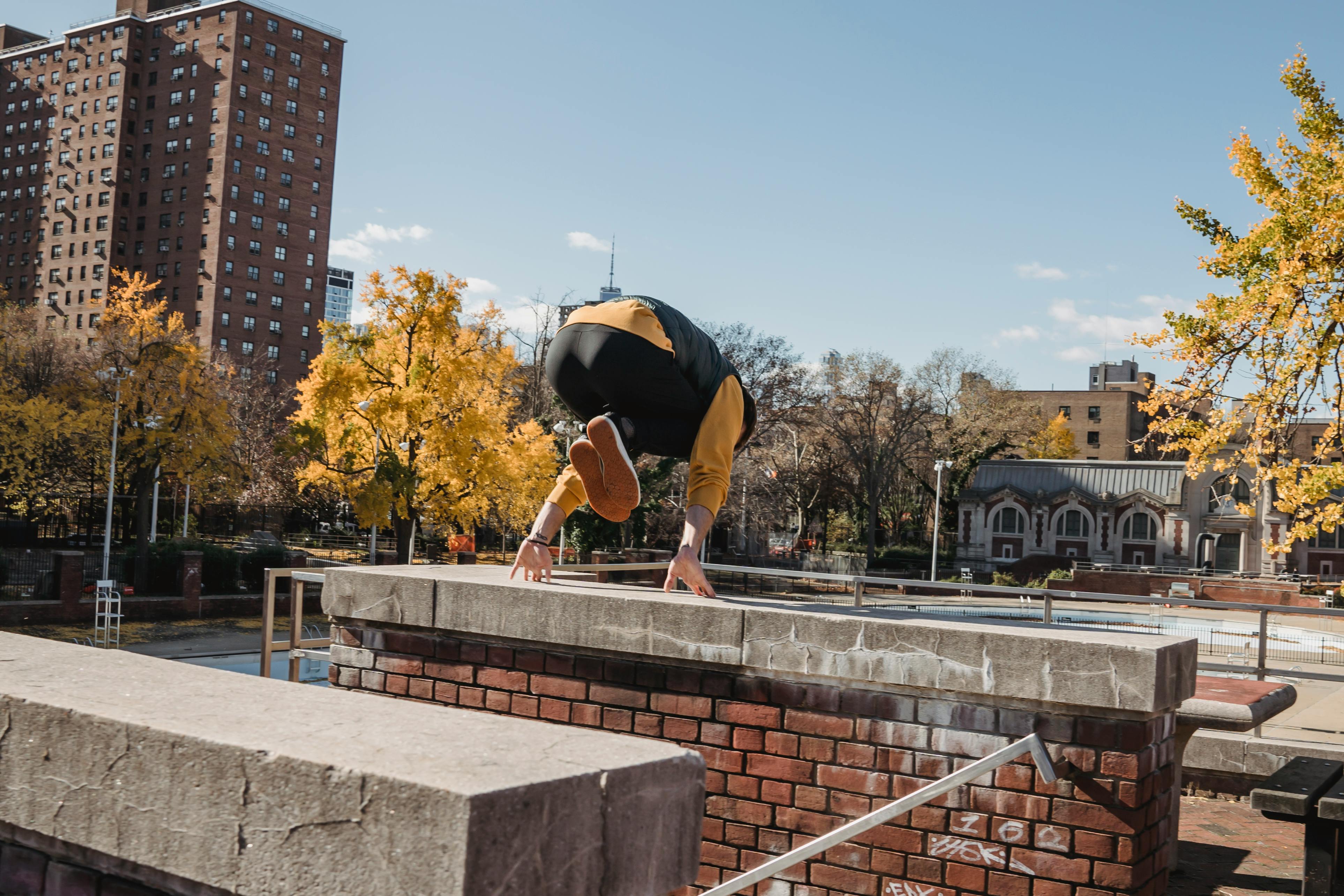
Step 3: Drive and Flight
Drive explosively through your legs while swinging your arms forward and upward, this arm swing does real work, it’s not decorative. Aim to arc up and over toward your target rather than jumping flat and low, an arc gives you more control on the way down and directs your landing energy into the target instead of skidding across it. Keep your knees tucked and eyes locked on the landing spot the entire time.
Step 4: The Landing
Land on the balls of your feet, never heel-first, with your knees bending to absorb impact immediately on contact. A clean precision lands and stops, no extra hop or stumble forward. If you find yourself carrying momentum past your landing point, that’s a sign to dial back the distance you’re attempting, not to muscle through it.
Common Mistakes
- No clear target: jumping at a general area instead of one exact spot leads to messy, inconsistent landings
- Weak arm swing: relying on legs alone leaves real distance and stability on the table
- Stiff body in the air: a rigid posture with trailing legs limits your ability to adjust mid-flight if something’s slightly off
- Heel-first landings: sends far more shock through your joints than a forefoot landing absorbs
How to Practice Safely
Start with two low, stable surfaces (curbs work well) close enough together that the jump feels almost trivial. Increase the distance gradually, only once your landing is consistently clean and controlled at the current gap. A simple, genuinely useful benchmark many traceurs use: count how many of your own foot-lengths you can jump, this gives you a real, trackable sense of progress independent of any specific location.
Frequently Asked Questions
How far should a beginner be able to precision jump?
There’s no universal number, it depends heavily on height, leg strength, and confidence. Progress by small increments from a distance that already feels controlled, rather than chasing a specific target distance.
Should I practice precision jumps at height right away?
No. Master the technique at ground level or minimal height first, where a missed landing costs nothing. Height should only be added once your landing technique is fully automatic, not something you’re still consciously thinking through.
Why do my shins keep getting scraped during practice?
This usually means you’re landing short and catching the edge of the target with your shin rather than clearing it cleanly. It’s a sign to either close the distance slightly or work on generating more lift through your arm swing and leg drive.
Where to Go Next
Precision jumps pair directly with landing safety. Read next: How to Build Ankle Strength for Safer Landings and 10 Parkour Vaults for Beginners.
Pingback: Rail And Ledge Walking: Building Real Balance - ParkourChase
Pingback: 10 Advanced Parkour Moves, Explained (and What Each Requires)
Pingback: How To Do A Kong Vault (and Monkey Vault) Safely
Pingback: Plyometrics For Parkour: Building Explosive Power Safely - ParkourChase