The five mistakes that actually cost beginners the most are: skipping the warm-up, landing badly, training too often without recovery, chasing advanced moves before the fundamentals are solid, and neglecting conditioning entirely. Each one is fixable, and each one is a leading cause of the injuries that end up interrupting training for weeks.

This matters more than it might sound. A cross-sectional study of 266 traceurs recorded an average of 1.9 injuries per practitioner per year of practice. Most of those aren’t freak accidents, they trace back to a small number of avoidable habits formed early.
Mistake 1: Skipping the Warm-Up
Cold muscles are stiffer and less pliable than warm ones, which is exactly why so many parkour injuries happen in the first few minutes of a session. The fix isn’t a token two minutes of arm circles, it’s a specific order: raise your pulse, then quadrupedal movement, then dynamic mobility, then ankle and wrist prep, then a scaled-down version of whatever you’re about to train. Roughly fifteen minutes.
Fix it: The Complete Pre-Training Warm-Up Checklist
Mistake 2: Landing Badly
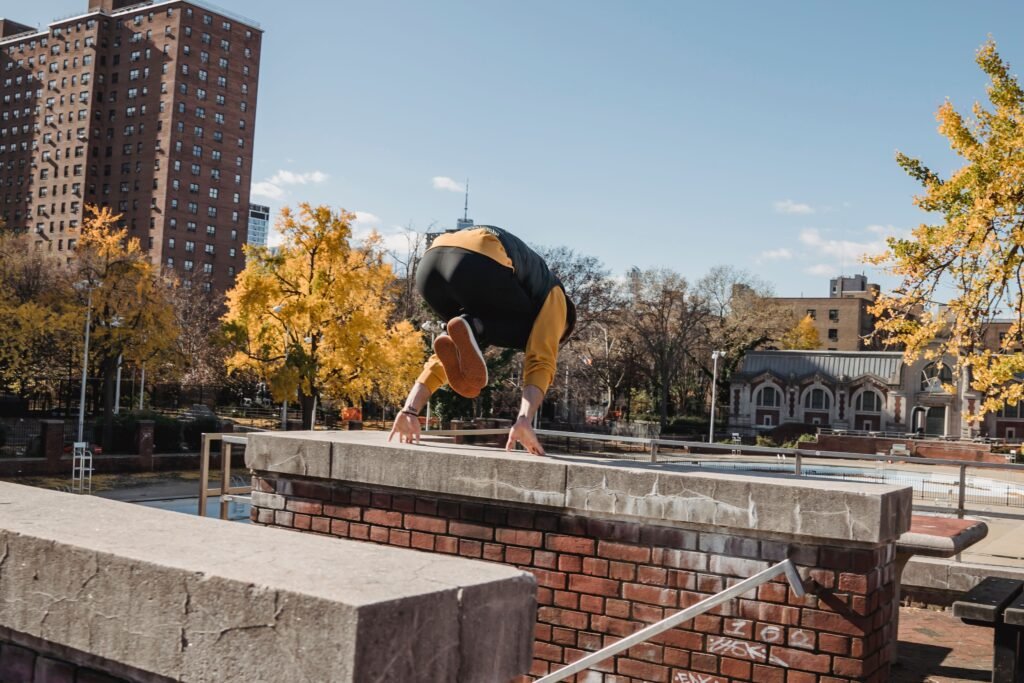
Landing is the single most frequent cause of parkour injury, ahead of falling or striking an obstacle. Heels first, legs locked, all the force arriving at once through your skeleton rather than being absorbed by muscle. The tell is sound: a loud landing means the impact went somewhere it shouldn’t. Ankle sprains are the most commonly reported individual injury in the sport, and landing technique is the primary lever on that.
Fix it: Landing Progressions: From Flat Ground to Height and How to Build Ankle Strength for Safer Landings
Mistake 3: Training Too Often
Enthusiasm in week two turning into five sessions a week is one of the most reliable routes to an overuse injury by week four. Connective tissue adapts more slowly than muscle does, so the damage accumulates quietly while you feel fine. Two to three sessions a week with at least 24 to 48 hours between them is the range that actually builds skill without breaking you down.
The warning signs show up before the injury does: joint soreness that doesn’t fade after 48 hours, performance declining session to session, a nagging ache in the same spot.
Fix it: How Often Should Beginners Train Parkour Each Week? and What Actually Helps Muscles Recover
Mistake 4: Rushing Past the Fundamentals
Attempting advanced moves before the basics are automatic doesn’t accelerate progress, it exposes the gaps. The real marker of readiness isn’t motivation, it’s consistency: can you land quietly from moderate height, roll properly, execute a basic vault cleanly on the first attempt most of the time, and move through a short sequence without stopping to reset? If any of those is still inconsistent, that’s the actual work.
The most common version of this error is adding height and complexity at the same time. Change one variable, not both.
Fix it: How to Progress From Beginner to Intermediate Safely
Mistake 5: Skipping Conditioning
Conditioning is directly linked to fewer ankle and knee injuries in traceurs who do it consistently, compared to those who skip it. It’s also the least visible part of training, which is exactly why it gets dropped. Core strength in particular carries over more than most beginners expect, your trunk’s job in parkour is transferring force between upper and lower body during a vault and absorbing rotation on landing, not flexing your spine.
Fix it: 5 Parkour Conditioning Exercises You Can Do at Home and Core Strength Exercises That Actually Transfer
Frequently Asked Questions
Which of these mistakes causes the most injuries?
Landing, by a clear margin. Landing is the most frequently reported cause of injury in parkour injury surveys, ahead of falling or striking an obstacle. If you only fix one thing on this list, fix that.
Do I need protective gear as a beginner?
Shoes with genuine grip matter most, and they’re doing real work on wall-based movements specifically. Knee and elbow pads are worth using while learning moves with a high scrape rate, like the cat leap. Pads don’t substitute for technique though, they buy you margin while you build it.
Is it a mistake to train alone?
Not inherently, but injury survey data does show injuries are more likely during solo or outdoor training than group or indoor sessions. The gap is real and manageable with specific precautions rather than by avoiding solo training entirely.
Where to Go Next
If you’re early in your training, start here: How to Start Parkour Safely and Common Parkour Injuries by Body Part.