To do a safety vault, approach the obstacle straight on, put one hand flat on top, step the opposite foot up onto it, then step your other leg through the gap between your hand and foot and land moving forward. It’s also called the step vault, and it’s the first vault most beginners learn because it’s slow, simple and keeps a hand and a foot on the obstacle at the key moment.
Why Learn the Safety Vault First
Rockstar Academy describes it as often the first vault beginners learn because of its simplicity and low risk. You can do it at walking pace, and at the moment you cross the obstacle you’re supported by a hand and a foot. Breaking Muscle teaches it as one of three beginner vaults, with the speed vault as the faster progression from it.
Pick the Right Obstacle
London Parkour suggests a wall from roughly thigh height to just over hip height. Breaking Muscle adds a quick safety check before you start: look for loose debris on the ground, and make sure the top isn’t wet, rough or unstable.
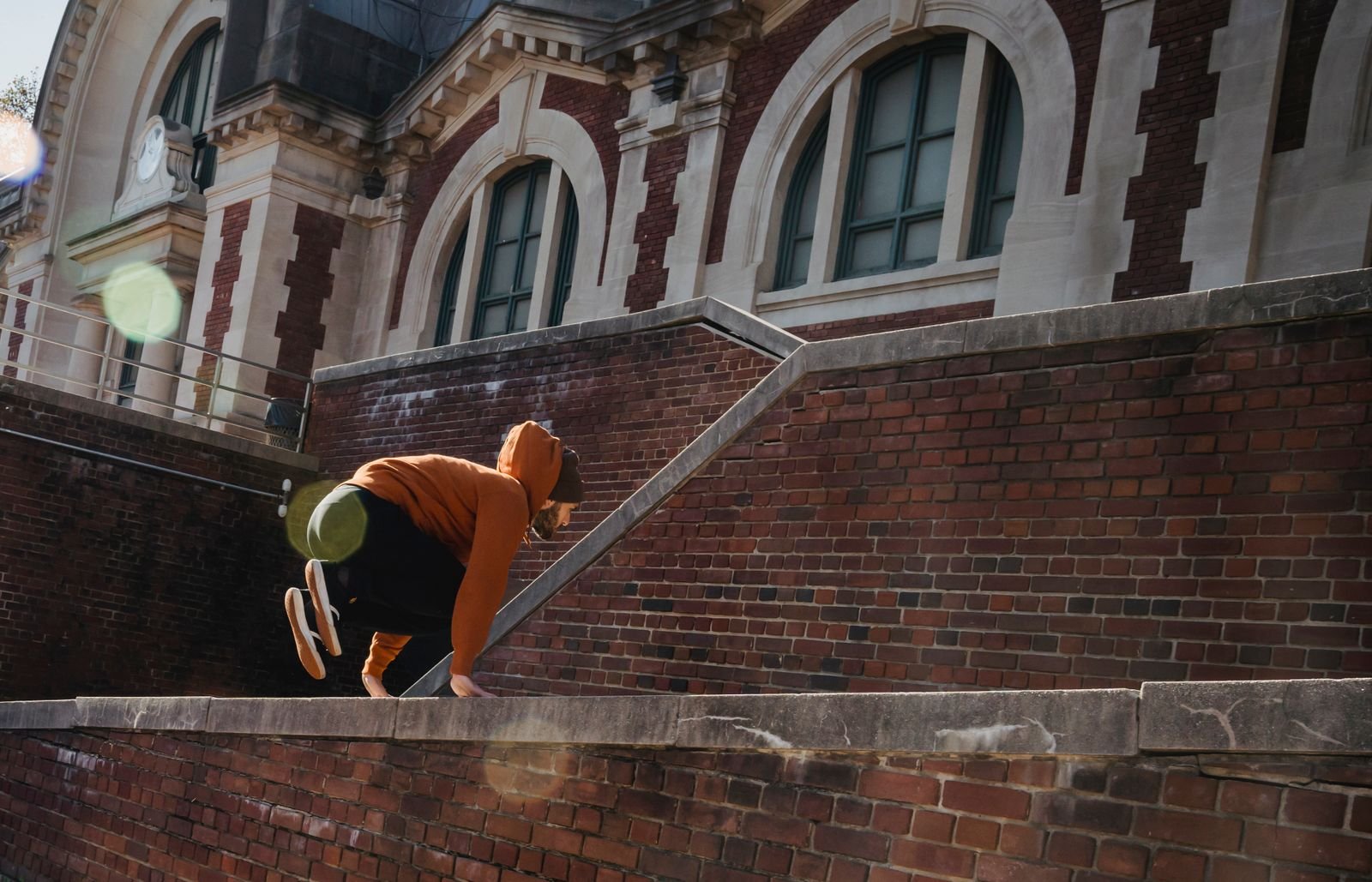
How to Do a Safety Vault, Step by Step
- Approach straight on, slowly. Walk towards the obstacle in a straight line. Speed comes later.
- Plant one hand flat on top. Use the whole palm, not your fingertips. London Parkour wants the pressure from the middle of your hand to the ball of your thumb.
- Step the opposite foot up. Breaking Muscle has you push off the ground and bring your outer leg up so the ball of that foot lands on the obstacle. You’re now balanced between one hand and the opposite foot.
- Keep your weight forward. Stack your shoulder over your hand and shift your weight through your arm rather than leaning back onto the foot.
- Step through the gap. Bring your free leg through the space between your hand and foot and reach it to the ground on the far side.
- Release and keep moving. Take your weight onto the landing leg, let go with your hand and step on. Land softly and quietly.
The Progression
- On the floor. London Parkour’s progressions start with the shape on flat ground, so you can learn the hand, foot and step-through without an obstacle.
- Two hands, then one. Begin with both hands on the wall and one foot on top, push your hips high, then take the inside hand away as you step through.
- Walking, then jogging. Once the shape is clean, add a little speed to the approach.
- Both sides. Breaking Muscle says your non-dominant side will feel awkward at first. Train it anyway.
Common Faults and Fixes
These come from London Parkour’s list of step vault faults:
- Steepled fingers. Keep your hand flat. Raised fingers strain the joints.
- Weight on the leg. Usually a sign you’re not yet comfortable on your arms. Practise on the floor and use two hands to build confidence.
- Hand and foot too close together. This forces your hips too high. Spread them wider.
- Knee collapsing down. Turn the knee up and push through the arm and leg.
- Foot turned outwards. Keep it facing forward with pressure on the ball of the foot.
- Curving around your arm. Aim for a straight line across the obstacle.
- Speed before technique. Chasing flow before the shape is clean builds bad habits.
One point where coaches differ is the landing. Rockstar Academy finishes the vault by landing softly on both feet. London Parkour treats a two-foot landing as a fault, because it stops your momentum, and prefers landing on one foot and stepping through. If you want to keep moving, the one-foot landing is the one to work towards.
Frequently Asked Questions
Is the safety vault the same as the step vault?
Yes. Different schools use different names for the same movement. London Parkour calls it the step vault.
How high should the obstacle be?
Start between thigh and hip height. Much lower and you’ll simply step over it. London Parkour’s later goal is a wall of about head height, but that comes much later.
What vault should I learn after the safety vault?
The speed vault is the natural next step. It uses the same one-hand support with a faster approach and no foot on the obstacle.
Where to Go Next
Move on with How to Do a Speed Vault Correctly, or see where this fits in 10 Parkour Vaults for Beginners. If you haven’t learned to roll yet, start with How to Do a Parkour Roll.