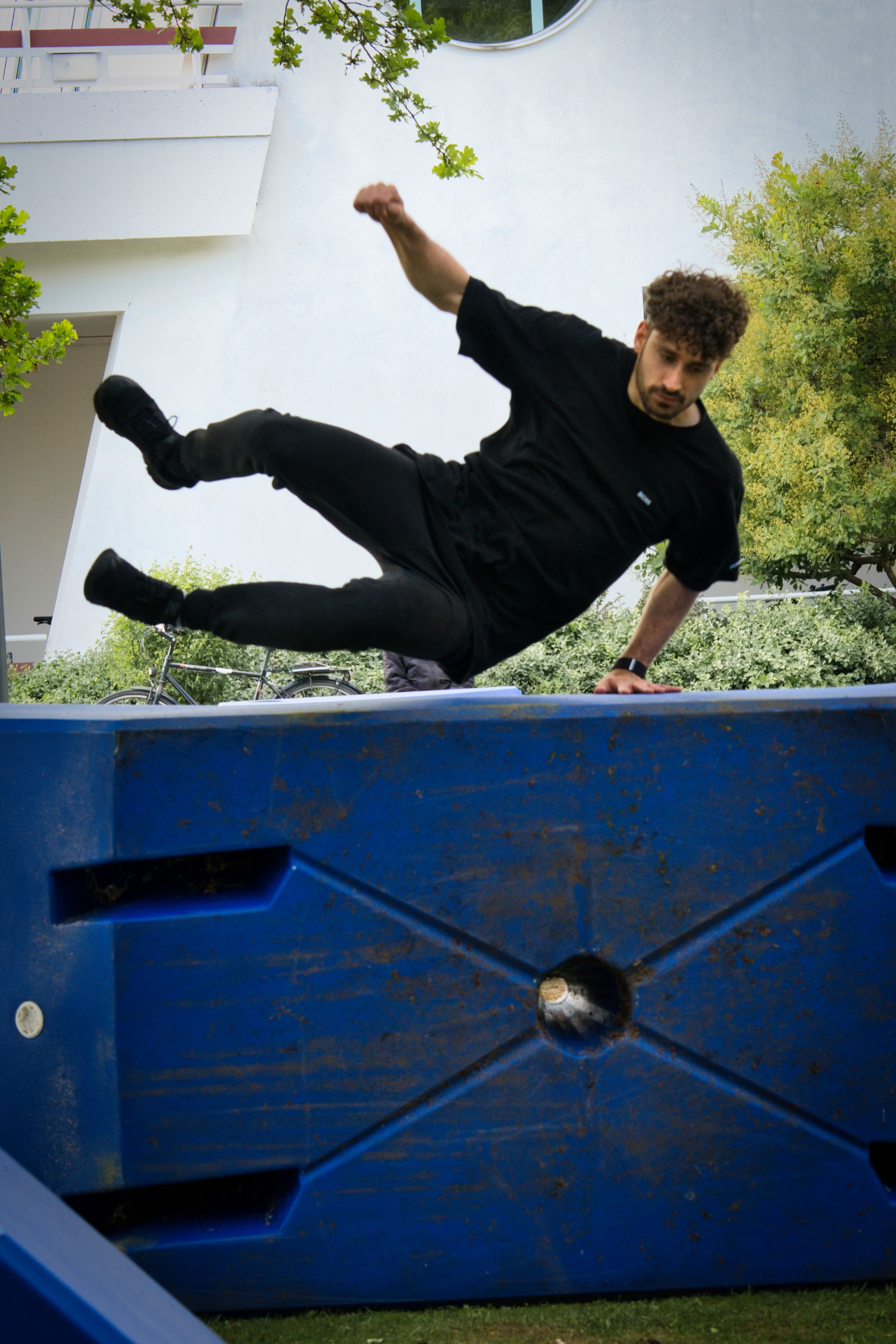
The speed vault takes you over an obstacle sideways with one hand planted, without breaking stride. You push off one foot, plant the hand on the same side, swing both legs over together, land and keep running. It’s the vault most traceurs use most, and the one thing that ruins it is hesitating.
Speed Is the Technique
Most vaults work fine slowly. This one doesn’t, and that’s the thing to understand before you start. Your run-up is what carries you over the obstacle. Your hand is there to keep you balanced in a horizontal position, not to lift you.
American Parkour’s tutorial is blunt about the failure mode: a last moment of doubt costs you most of your speed, and that kills the essential element of the technique. Half-committing to a speed vault doesn’t make it safer, it makes it worse. If you’re not going to commit, use a safety vault instead.
Match Your Hand to Your Foot
This is the detail beginners get wrong. If you take off from your right foot, you plant your right hand. Left foot, left hand. Same side.
Your final step should land a few feet out from the base of the obstacle, on that matching foot. Cross the wires and your body ends up rotating the wrong way, which is why some people find the movement fights them no matter how fast they run at it.
Step by Step
- Run at the obstacle straight on, at genuine pace.
- Take your final step a few feet out, on the foot matching your vaulting hand.
- Push off at roughly 45 degrees toward the top of the obstacle. Your body should now be ahead of your feet.
- Bring your lead hand down onto the top as your legs and torso rotate around toward it. At hand contact you’re close to parallel with the ground.
- Swing both legs over together to one side, legs staying together rather than splitting.
- Land and run out. One foot first for a running exit, or both feet if the obstacle was high.
Where to Learn It
A waist-height ledge or rail with grass on the far side. Waist height matters because too low and you’ll just step over it, too high and you’ll stall. Grass matters because the first few attempts usually end with a stumble on the exit.
Train both sides. A speed vault you can only do off your right foot is one you’ll have to skip whenever the approach doesn’t suit you.
Two Useful Variations
Turn it into a safety vault by placing your outside leg on the obstacle as you pass, then swinging the inside leg through. This keeps you higher and slower, useful when the far side turns out to be less inviting than it looked.
Turn it into a two-handed vault by bringing your outside hand down next to the inside one. More stable, slightly slower, good on obstacles that are wider than expected.
Frequently Asked Questions
What’s the difference between a speed vault and a lazy vault?
Mostly the approach. A speed vault comes in straight and leaves straight. A lazy vault comes in at an angle, which suits obstacles sitting diagonally across your line. The leg swing looks similar from the outside.
Why do I keep clipping the obstacle with my trailing foot?
Usually legs splitting apart mid-vault, or not enough lift from the take-off step. Keep your legs together as a single unit and push a bit harder at 45 degrees rather than flat forward.
Is the speed vault safe on a rail?
It works on rails and it’s less forgiving than a flat wall, since your hand has a narrower surface to balance on. Learn it on a solid flat-topped ledge first, then move to rails once the hand placement is automatic.
Where to Go Next
The speed vault sits at the heart of the vault family. Read next: 10 Parkour Vaults for Beginners and How to Chain Parkour Movements Into Smooth Flow.