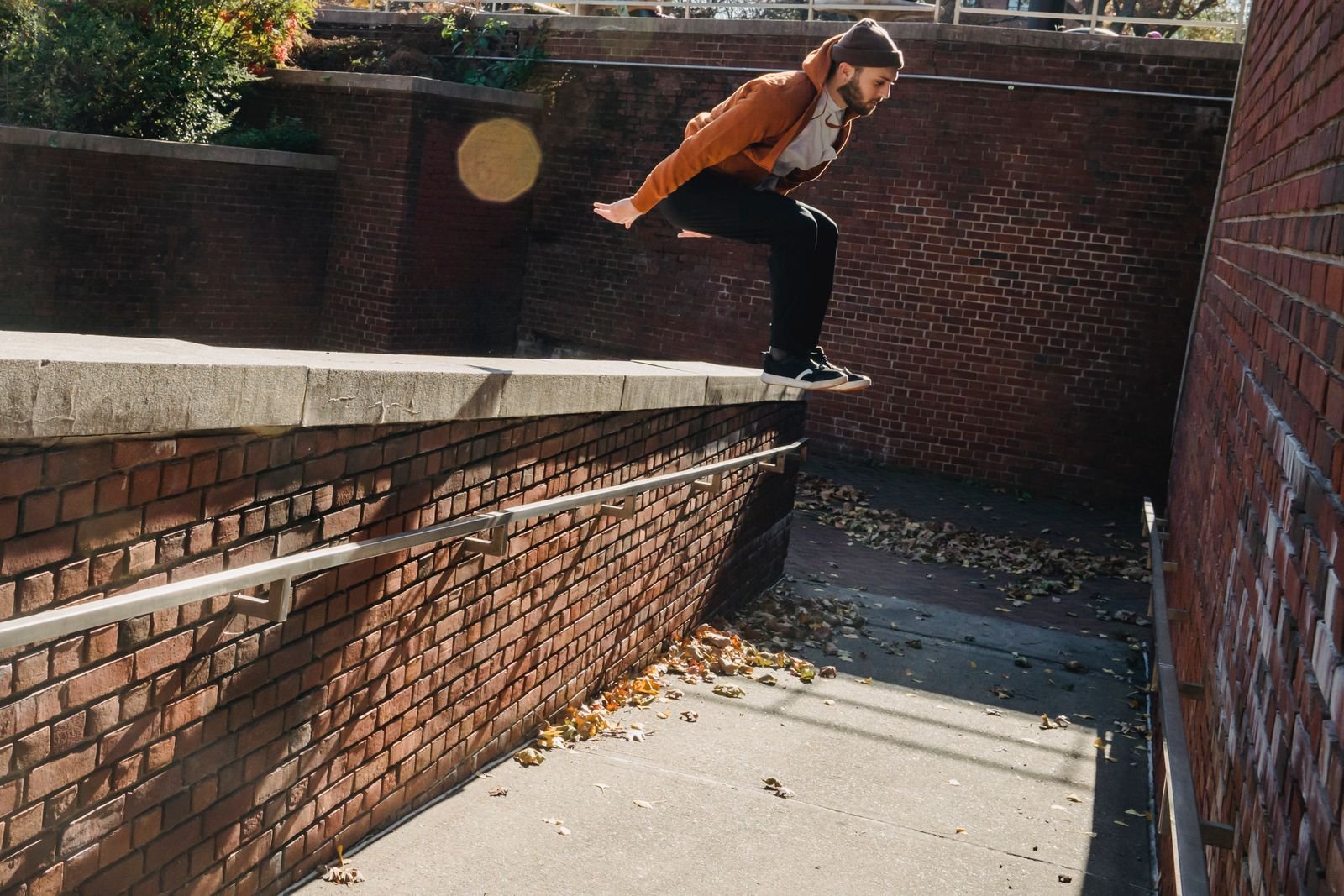
To do a lazy vault, approach the obstacle at an angle, put your nearest hand on top, and swing your inside leg and then your outside leg over sideways. As your legs pass over, place your second hand on the obstacle, release the first, and push off to keep running. It’s a smooth, low-effort way over a hip-to-chest-high wall when you’re moving alongside it rather than straight at it.
When to Use a Lazy Vault
Wikipedia’s overview of parkour vaults describes the approach as parallel or diagonal to the object. That’s what sets it apart from the safety and speed vaults, which go straight at the obstacle. Breaking Muscle describes coming at it from the side, as if you were running past, and carrying on along the obstacle afterwards.
Danish parkour team JIYO suggests a solid, non-slip obstacle between hip and chest height.
How to Do a Lazy Vault, Step by Step
- Approach at about 45 degrees. JIYO recommends a relaxed pace at this angle.
- Take off close to the obstacle. JIYO puts your take-off foot about half a metre away, pushing off with the leg furthest from the obstacle.
- Plant your nearest hand. Put the hand closest to the obstacle on top and shift your weight sideways and down that arm.
- Swing your legs over. Your inside leg goes up and over first, followed by your outside leg.
- Swap hands. As your second leg clears the edge, place your free hand on the obstacle to take over the support, and release the first.
- Push off and run on. JIYO has you land with your legs apart and push off with the last hand so your momentum keeps flowing forward.
The Progression
- Sit on a soft obstacle. JIYO’s first drill uses something soft, like a padded plinth. Just swing your legs up and sit on top until the movement feels natural.
- Go all the way over, slowly. Keep the pace calm and focus on the hand swap.
- Add a little speed. Once you’re confident, more speed gives you more energy to clear the obstacle.
- Train both sides. Breaking Muscle’s general advice for beginner vaults is to drill both directions and keep every contact quiet.
JIYO adds one tip that surprises beginners: don’t be afraid to lean back as your weight moves across. Shifting your body weight is what creates the flow.
The Thief Vault Variation
The thief vault flips the leg order. Wikipedia describes it as similar to the lazy vault, except that the inside hand touches the obstacle and the outside leg goes over first. Learn the lazy vault first. Once that feels easy, the thief vault is a small change to the same pattern.
Don’t confuse either with the side vault, where both hands go on the obstacle and your legs pass alongside your arms, parallel to the obstacle.
Frequently Asked Questions
Is the lazy vault harder than the safety vault?
Slightly. The safety vault keeps a foot on the obstacle, while the lazy vault asks you to swap hands mid-movement with both legs in the air. Most beginners learn the safety vault first.
Which leg goes over first in a lazy vault?
The inside leg, the one closest to the obstacle. If the outside leg goes first, you’re doing a thief vault.
Can I do a lazy vault over a rail?
Learn it on a wide, solid surface first. A rail gives you much less room for your hands, so move to one only when the vault is consistent on a wall.
Where to Go Next
If you haven’t learned it yet, start with How to Do a Safety Vault. For a faster straight-on option, read How to Do a Speed Vault Correctly, and see the full list in 10 Parkour Vaults for Beginners.