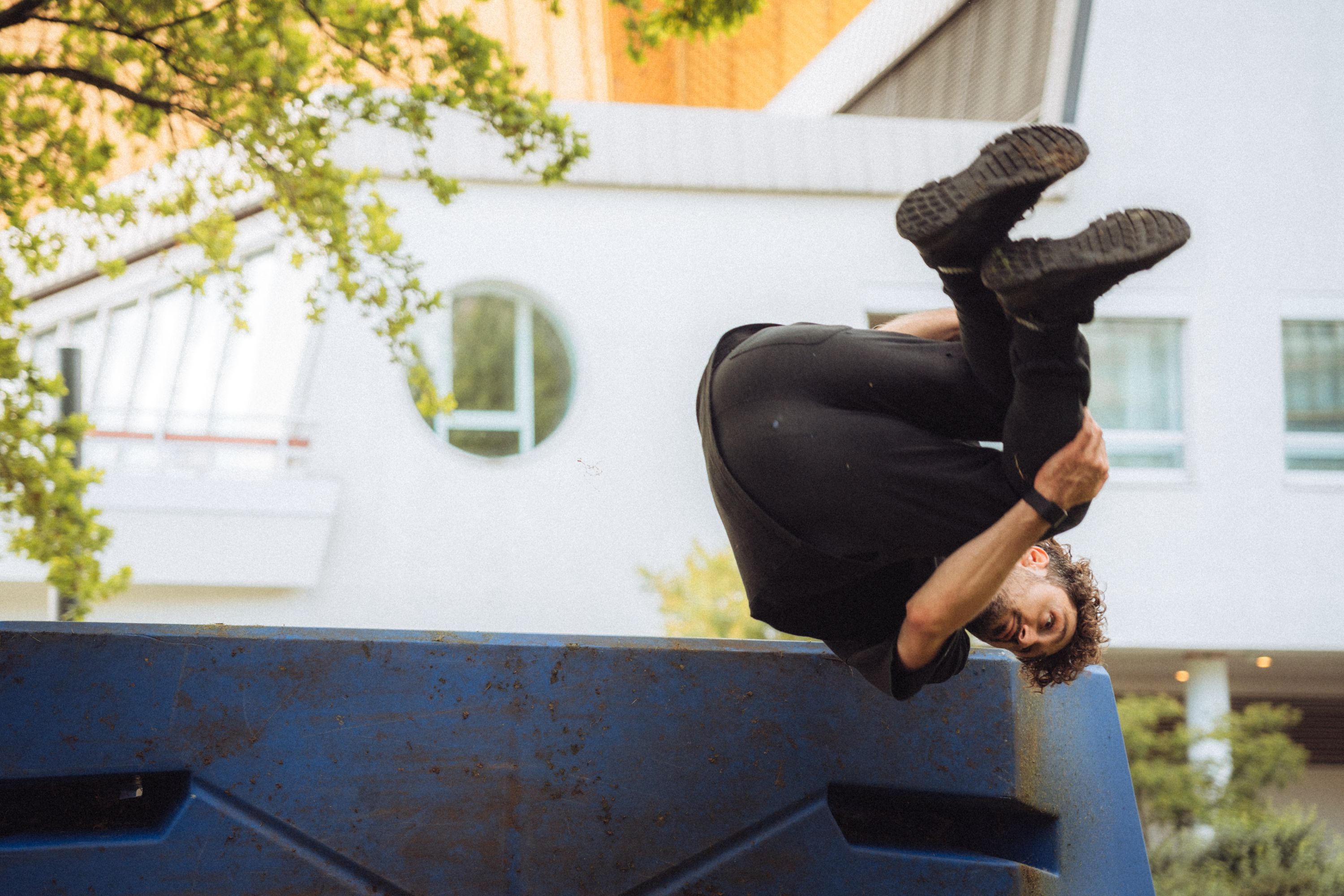
A wall flip is a backflip performed off a vertical surface. It is not a parkour movement in the strict sense, it’s freerunning, and the distinction matters for how you should learn it. Realistically it takes months if you already have gymnastics or martial arts background, and years if you don’t. It should be learned with coaching, on mats, and not from an article.
First, Three Moves That Get Confused
These names get used interchangeably and they shouldn’t be:
- Wall flip: a backflip off a wall face. Your feet push off the wall and you rotate backwards through the air.
- Wall spin: a horizontal rotation where your hands are the only point of contact with the wall and your body spins around them, closer to a side flip in shape.
- Palm spin: the same rotation performed with hands on top of a low wall rather than flat against a vertical one. This is the beginner version and the standard entry point.
Why This Isn’t Really Parkour
Worth being straight about. Parkour is oriented around efficient movement, getting from A to B, and a flip does nothing for that. Reference sources describe flips as rarely used in parkour because they rarely aid efficiency, widely used in freerunning and tricking where expression is the point, and genuinely controversial within the parkour community as to whether they belong at all.
None of that means don’t learn it. It does mean being clear that you’re learning a freerunning skill for its own sake, not a technique that will make you better at moving through your environment. If you want the movement that does use a wall efficiently, that’s the wall run or the tic tac.
The Honest Prerequisites
Before a wall flip is a reasonable thing to attempt, you want a clean, consistent standing backflip on flat ground, landed without hesitation and without a spotter. If you can’t do that, the wall version adds a vertical surface, an angled push-off, and a less predictable rotation to something you haven’t yet mastered in its simplest form.
You also want somewhere soft. Coaching facilities teach this over mats or foam pits for a reason, and the reason is that a mistimed inversion lands you on your head or neck.
How Coaches Actually Progress It
The standard progression for wall rotations is gradual and deliberately boring:
- Palm spin on a low wall. Hands on top of the wall, body rotating around them. Low consequence, teaches the rotation pattern.
- Angled surface. Coaching gyms use a tipped trapezoid or similar so the “wall” starts closer to horizontal.
- Raise the angle incrementally. Over sessions, not within one session.
- Vertical wall, with mats. Only once every earlier stage is comfortable.
Notice that flat vertical walls sit at the end, and at least one established academy explicitly keeps them out of their beginner curriculum entirely.
The Commitment Problem
The specific danger with wall rotations is bailing halfway. Chris Keighley, a coach with Parkour Generations, puts it bluntly: pull out too early and you slam into the wall. He also gives the realistic timeline, that someone with no sporting background would need years to nail it, while someone already fit and strong might get there in months.
That’s the honest answer to “how long will this take”, and it’s a long way from a nine-step article.
Frequently Asked Questions
Can I learn a wall flip from a video or article?
You can learn what it involves. You should not learn the execution that way. This is an inversion with real head and neck risk, and the failure mode is not a scraped shin. Find a gym with mats and someone qualified to spot you.
Should I learn a wall spin or a wall flip first?
Wall spins are generally considered the more approachable entry into wall rotations, because the palm spin gives you a genuinely low-consequence version to build from. A wall flip depends on already owning a standing backflip.
Do I need to flip at all to be good at parkour?
No. Plenty of highly skilled traceurs never flip, and some deliberately avoid it on the grounds that it isn’t part of the discipline. Flips are a freerunning addition, not a parkour requirement.
Where to Go Next
For the efficient wall movements that genuinely are parkour: How to Wall Run and Parkour vs. Freerunning: The Real History Behind the Split.