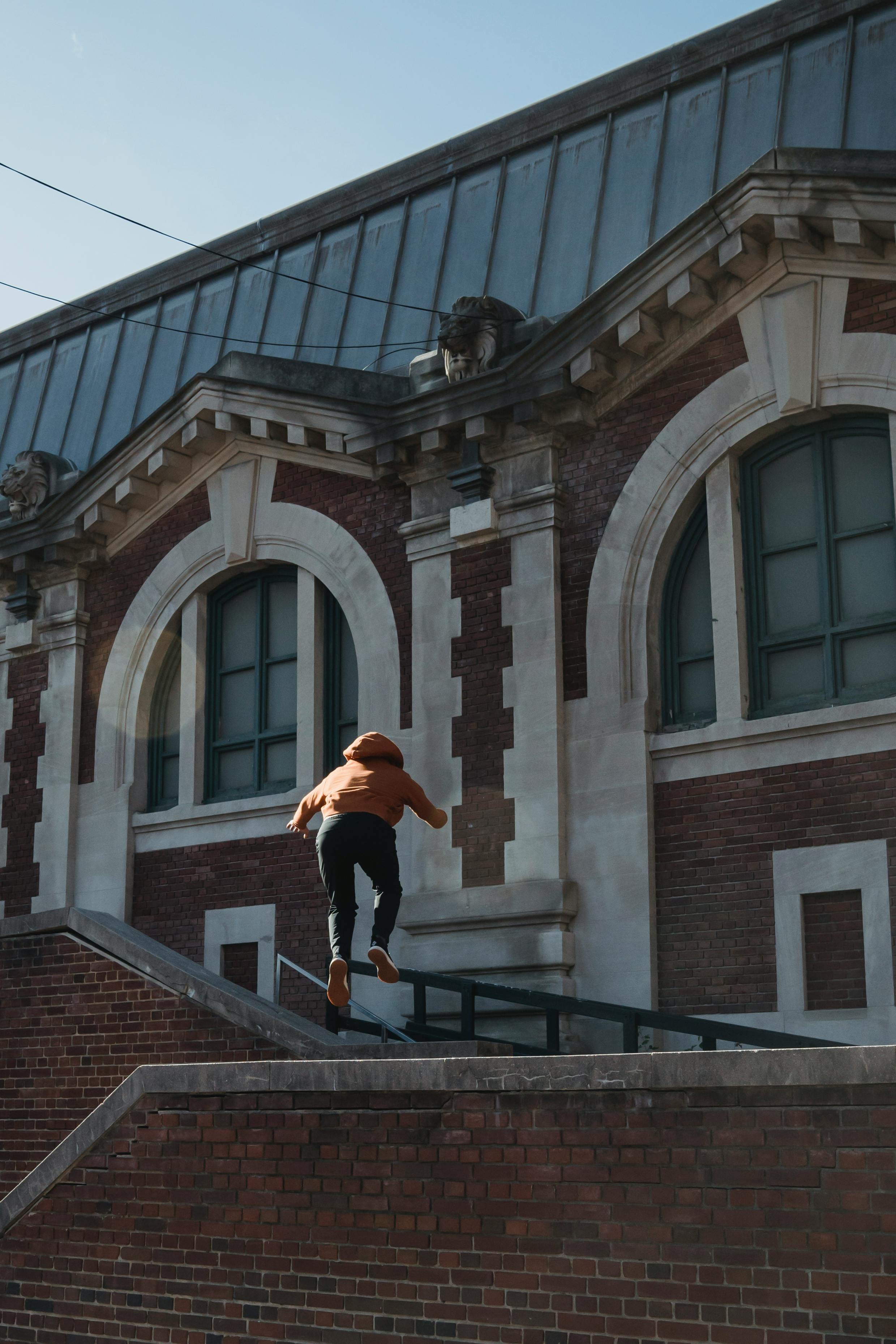
A turn vault takes you over a rail or wall while rotating 180 degrees, so you finish facing back the way you came, usually hanging in a cat position. It isn’t a speed move. Its real job is control on the way down: by ending up hanging off the obstacle, you cut the height of the drop below you roughly in half.
Why This Vault Matters More Than It Looks
Most vaults are about getting past something quickly. The turn vault is about arriving somewhere safely. Coaching notes from Parkour Labs make the case plainly: it looks like a situation you’d rarely need, and it’s actually one of the most used vaults in parkour, precisely because it’s the standard tool for descending from heights and drops in control.
Think about a rail at the edge of a raised walkway with a drop on the far side. Vaulting it normally commits you to the full drop, facing outward, blind. Turn vaulting it leaves you hanging off the rail facing the wall, with your feet already partway down and your eyes on the landing.
Hand Position
This is the part that makes the rotation work. One hand goes on in an underhand grip, the other overhand. The underhand hand is the one you rotate around, and it’s what lets your body turn without your wrist having to.
Put both hands on overhand and you’ll find the turn either locks up or forces you to release early. Get the grip right before you worry about anything else.
Step by Step
- Approach the obstacle at a controlled pace. This is not a move you sprint into.
- Place your hands, one underhand, one overhand, on the top edge.
- Push off with your feet and bring your legs over the obstacle.
- Rotate 180 degrees around your underhand grip, letting your head lead. Your torso follows wherever your head points.
- Finish in the cat position: facing the obstacle, arms above you, knees bent, feet on the wall or as close to it as you can manage.
- Exit deliberately. Drop and land, drop into a roll, launch to another obstacle, or traverse sideways.
Learn the Rotation Before the Drop
Find a hip-height rail with flat ground on both sides and no drop at all. Practise the rotation there until it’s automatic. Don’t add height while you’re still thinking about which hand goes where.
Then refine it in stages: first just land close to the obstacle after the turn, then work toward getting your feet actually on it, then hold the full cat position. Landing with your feet vertical against the obstacle comes with practice rather than effort.
Don’t Add Momentum
Worth repeating because it’s the most common error: a turn vault should be swift but not fast. Extra speed throws you outward from the obstacle, which is precisely the opposite of what the move is for. The whole sequence should flow without hesitation at a controlled pace.
Train it on both sides too. A turn vault you can only do one way is one you’ll be unable to use half the time you need it.
Frequently Asked Questions
Is a turn vault the same as a reverse vault?
No. Both involve rotation, but a reverse vault spins you backwards over the obstacle and you carry on in your original direction. A turn vault leaves you facing back the way you came, hanging off the obstacle. Different purposes entirely.
What height rail should I learn on?
Hip height or a little above works well, with flat ground on both sides while you’re learning. The drop comes later, once the rotation and the cat landing are both reliable.
Why do I keep swinging away from the wall?
Usually too much approach speed, or releasing the underhand grip too early. Slow the entry down and hold that grip through the rotation, and you’ll stay tucked against the obstacle instead of pendulum-ing off it.
Where to Go Next
The turn vault ends where the cat leap begins. Read next: The Parkour Cat Leap and 10 Parkour Vaults for Beginners.