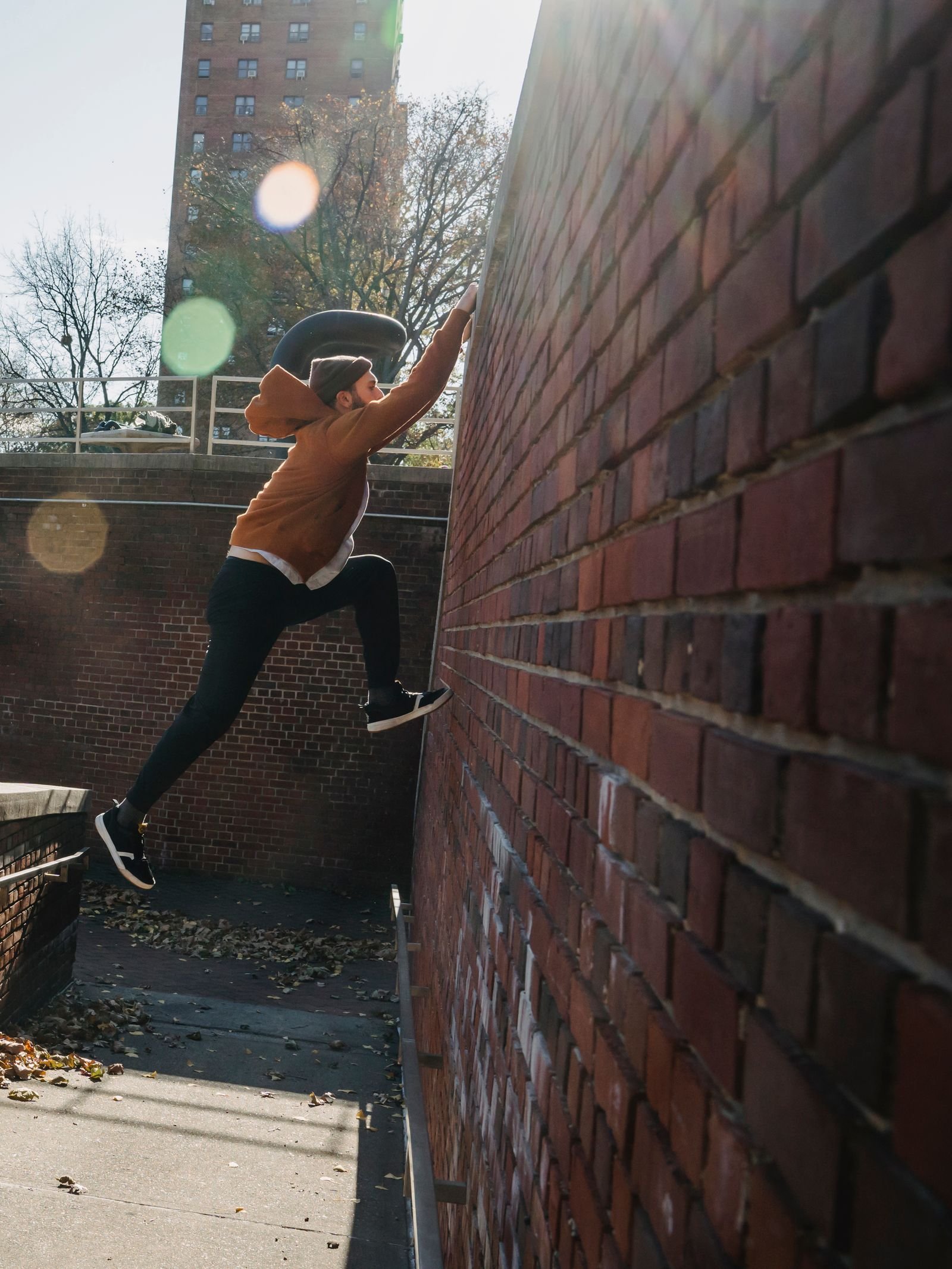
A wall spin is a freerunning move where you run at a wall at an angle, jump, plant your hands on the wall and swing your legs over your head in an arc, rotating around your hands before landing on your feet and running on. It’s an advanced move. Learn palm spins first, start on an angled surface rather than a vertical wall, and practise over mats, ideally with a coach.
Is a Wall Spin Parkour or Freerunning?
Freerunning. It doesn’t get you over an obstacle more efficiently. It’s about style and control. We cover the difference in Parkour vs. Freerunning, and the wall spin sits alongside the other advanced spins and flips in 10 Advanced Parkour Moves, Explained.
What to Learn First
- The palm spin. Coach magazine recommends building up with palm spins, with your hands on top of a low wall. Our guide to palm spins and lache covers the hand rotation.
- Comfort being upside down. Flash Mavi’s wall spin guide says you should be able to do a front flip and be comfortable dropping from more than 2 metres before you start.
- Strength and power. Coach lists core strength and leg power among the requirements, and parkour coach Chris Keighley notes that people without a sports background may need years rather than months.
How a Wall Spin Works
Coaches describe the details slightly differently, especially the take-off and hand position, so learn your version from a coach. The broad pattern is the same:
- Approach at an angle. In a tutorial credited to coach Ryan Ford on Lost Art of Hand Balancing, a 45 degree approach works best. Flash Mavi adds that you should run in with light, quiet steps rather than sprinting.
- Take off close to the wall. Ford’s version jumps off both feet about an arm’s length from the wall. Flash Mavi’s pushes off one leg towards the wall and swings the arms up.
- Plant your hands. In Ford’s version, the top hand points in your direction of travel and the bottom hand points towards the ground, acting as the pivot. Flash Mavi stresses that the fingers should point slightly downwards.
- Swing your legs over. Lean into the inverted position and bring your legs over your head without your feet touching the wall. Flash Mavi says to keep your knees and hips away from the wall and bend your legs enough to give your feet room.
- Release and land. Take the hands off in order as you come round, push away from the wall, and land as softly as you can.
Safe Progressions
- Palm spins on a low wall until the rotation is smooth in both directions.
- An angled surface before a vertical wall. Flash Mavi says not to attempt the wall spin on a vertical wall straight away, and an Instructables guide warns you can be badly injured learning your first one on a vertical wall.
- Mats, a foam pit and a partner. Flash Mavi recommends mats and an experienced partner. Keighley mentions parkour centres with foam pits as a place to practise.
- A vertical wall, low and soft first. Ford’s tutorial suggests a wall with something soft below it.
Common Mistakes
- Bailing halfway. Coach magazine warns that if you pull out too early, you’ll slam into the wall.
- Releasing your hands at the wrong moment. Flash Mavi says this can injure your elbows, and that falling before your legs have passed overhead can cause worse injuries.
- Letting the feet or knees hit the wall. Bend your legs and keep your hips away from the wall as you go over.
- Skipping the warm-up. Flash Mavi recommends warming up thoroughly. Our warm-up checklist works well.
Frequently Asked Questions
How long does it take to learn a wall spin?
Coach magazine estimates around four months of practice. Keighley adds that a fit, strong person might learn it in months, while someone without a sports background could take years.
Is a wall spin the same as a palm spin?
No. In a palm spin your hands are on top of a low wall or rail. In a wall spin they’re on the face of a vertical wall, and your body goes upside down.
Can I learn a wall spin on my own?
It’s not a good idea. Because the move puts you upside down next to a hard surface, the sources here all recommend mats, a soft landing area or a partner. A parkour gym with a coach is the safest place to learn.
Where to Go Next
Build up with Palm Spins and Lache, and get comfortable on walls with The Tic Tac and How to Wall Run.