Parkour has its own vocabulary, and much of it comes from French or from the community’s slang. This glossary explains 46 of the terms you’ll hear most often, grouped into culture, basic movements, vaults and freerunning flips, with a link to a full guide wherever we have one. Names vary between countries and coaches, so you’ll sometimes hear different words for the same move.
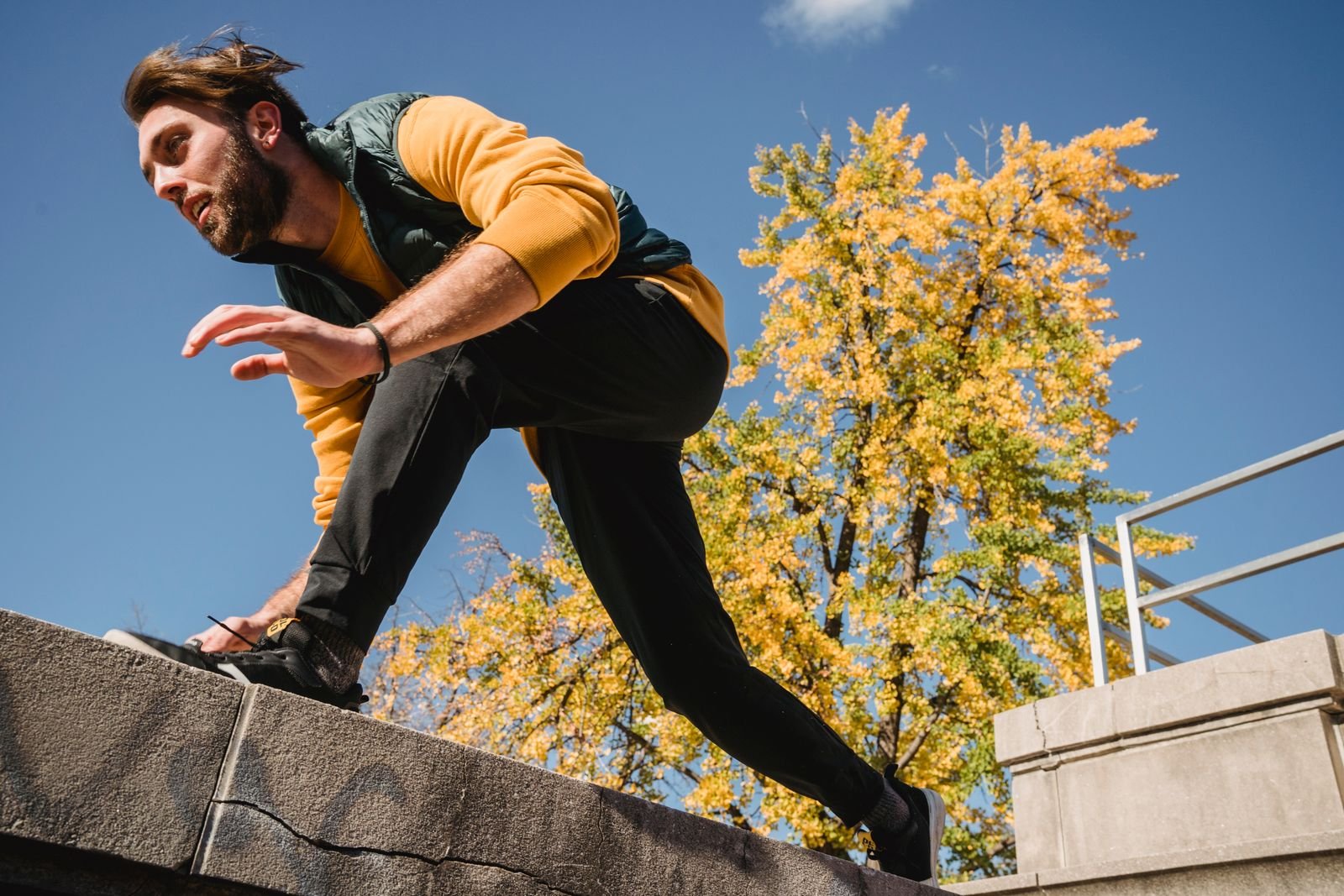
The general definitions here loosely follow Wikipedia’s parkour article and its list of vaults, alongside the technique guides on this site.
People, History and Culture
- Parkour. A self-led movement practice where you use only your body to move past obstacles, usually in urban spaces. The name comes from parcours du combattant, the military obstacle course training proposed by Georges Hébert.
- Traceur and traceuse. A parkour practitioner. Traceur is the masculine form and traceuse the feminine, from the French verb tracer, to trace. Informally, tracer can also mean to hurry.
- Freerunning. An acrobatic discipline that adds an aesthetic, self-expressive element, including flips and spins. Our article on parkour vs. freerunning explains the split.
- Art du déplacement. “The art of movement”, the name used by the Yamakasi members who continued training together after the original group split.
- Yamakasi. The French group, including David Belle and Sébastien Foucan, that developed the discipline in the 1990s. The name comes from the Lingala ya makási, “strong man, strong spirit”.
- David Belle. Credited with developing the methods of his father, Raymond Belle, and with keeping the term parkour.
- Sébastien Foucan. Credited with keeping the term freerunning for his own approach.
- Jam. A meet-up of traceurs to train together, lasting from a few hours to several days, often with people from different cities.
- Spot. A place to train, such as a set of walls, rails or a parkour park. See where to practise parkour.
- Line. A planned route through a spot, linking several movements. See how traceurs plan a line.
- Flow. Moving from one technique to the next without stopping, so you keep your momentum. See how to chain movements into flow.
Basic Movements
- QM (quadrupedal movement). Moving on all fours. A staple of parkour conditioning, covered in our home conditioning exercises.
- Precision jump (precision). Usually taken from standing: jumping and landing accurately with your feet on a small or narrow target. See How to Do a Precision Jump.
- Running precision. A precision jump taken from a run, off one foot, landing on both feet. See Strides and Running Precisions.
- Stride. A running bound from one foot to the other between obstacles, touching each with a single foot.
- Landing. Absorbing a jump or drop on the balls of your feet, ideally quietly. See Landing Progressions.
- Drop. Jumping or lowering yourself down from a height.
- Roll. A diagonal roll across your back from one shoulder to the opposite hip, turning the force of a bigger drop into forward movement. See How to Do a Parkour Roll.
- Cat leap (arm jump). Jumping to a wall and landing with your feet on its face and your hands gripping the top edge. See The Parkour Cat Leap.
- Cat hang (cat grab). The position a cat leap ends in: hanging from a ledge in a crouch, feet on the wall.
- Climb up. Moving from a hang on a ledge to standing on top of it or vaulting over.
- Wall run. Running at a high wall and pushing off it with one foot to reach the top. See How to Wall Run.
- Tic tac. A step off a wall used to change direction or gain height. See The Tic Tac.
- Rail balance. Walking along a rail or ledge. See Rail and Ledge Walking.
- Cat balance. Crawling on all fours along a rail. See Parkour Cat Balance.
- Underbar. Passing feet-first through a gap, such as between two rails, using your hands to steer. See The Parkour Underbar.
- Lache. Swinging from a bar and letting go to reach another bar or a landing. See Palm Spins and Lache.
Vaults
A vault is any movement over an obstacle where you put weight on it with your hands. All ten beginner vaults are compared in 10 Parkour Vaults for Beginners.
- Safety vault (step vault). One hand and the opposite foot on the obstacle, with the free leg stepping through the gap between them. See How to Do a Safety Vault.
- Speed vault. A straight-on vault with one hand planted, swinging both legs over sideways without breaking stride. See How to Do a Speed Vault.
- Lazy vault. You approach at an angle, put your inside hand on the obstacle and swing the inside leg then the outside leg over, swapping hands as you pass. See How to Do a Lazy Vault.
- Thief vault. Like a lazy vault, but the outside leg goes over first.
- Side vault. Both hands on the obstacle with your legs passing alongside your arms, parallel to the obstacle.
- Monkey vault. Both hands plant on the obstacle and your legs tuck through between your arms, with your hands landing before your feet leave the ground.
- Kong vault (cat pass). The diving version of the monkey vault, where your feet leave the ground before your hands touch. See How to Do a Kong Vault Safely.
- Double kong. A kong over a long obstacle where the hands are placed on it twice.
- Dash vault. Feet go over first and the hands push off behind you. See How to Do a Dash Vault.
- Kash vault. A combination of a kong or monkey vault and a dash vault.
- Turn vault. Vaulting while turning 180 degrees, often ending in a hang on the far side. See How to Do a Turn Vault.
- Reverse vault. A full 360-degree turn around your planted hand as you pass over, landing facing forward. See How to Do a Reverse Vault.
Freerunning Spins and Flips
These belong to freerunning rather than parkour. The flips should be learned on mats with a coach. They’re explained in 10 Advanced Parkour Moves, Explained.
- Palm spin. Rotating horizontally around your hands on top of a waist-height wall or rail.
- Wall spin. The same rotation with your hands flat against a vertical wall.
- Gainer. A backflip that travels forward, usually taken off one leg.
- Webster. A front flip taken off one leg.
- Kong gainer. A kong vault that turns into a gainer before you land.
- Corkscrew. A gainer with a full twist added.
- Wall flip. A backflip off a vertical wall. See The Wall Flip.
Frequently Asked Questions
What is a person who does parkour called?
A traceur, or traceuse for women. Many people simply say parkour practitioner. People who focus on flips and style often call themselves freerunners.
Why do some moves have two names?
As parkour spread from France to other countries, different schools gave moves different names. London Parkour, for example, calls the kong vault a cat pass, and the safety vault is also known as the step vault.
Which moves should a beginner learn first?
Landing, the roll, precision jumps and the safety vault. Our 30-Day Beginner Parkour Training Routine puts them in order.
Where to Go Next
Start training with How to Start Parkour Safely, and see what you’ll need in Parkour Gear for Beginners.