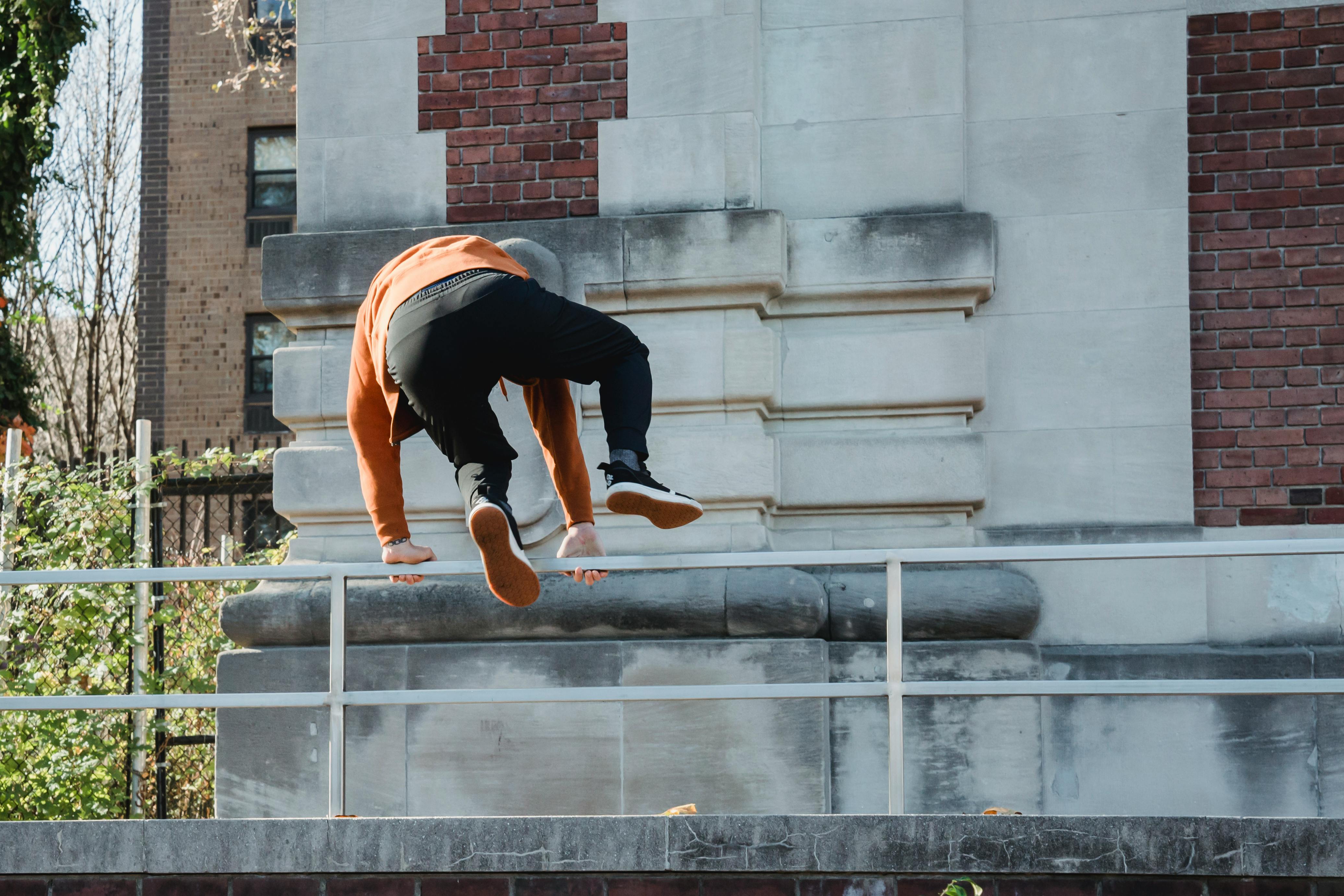
Two very different bar movements. The lache is a swing off a bar, released at the right moment to carry you to another bar or a landing. The palm spin is a horizontal rotation around your hands on a waist-height wall or rail. The lache is parkour, the palm spin is freerunning, and the lache is the one that will put you on your back if you get the timing wrong.
The Lache: Timing Is the Whole Skill
A lache looks simple: hang, swing, let go. What makes it genuinely difficult is that the release point is unforgiving in both directions.
Coaching guidance from Impulse Movement describes the two failure modes precisely. Release too late and all your power goes upward, leaving you with almost no forward momentum to carry you past where you started. Kick or release too early and you’re thrown straight into the ground. Finding that sweet spot is the single most valuable thing you can work on, and it comes from repetition at low consequence rather than from courage.
Done badly, a lache can send you off the bar helpless to land flat on your back. That’s not a reason to avoid it, but it is a reason to learn it in order.
The One-Swing Rule
The instinct is to build up momentum with several swings. Don’t, at least not while learning. Limit yourself to a single swing and see what distance you get.
Two reasons, both practical. The longer you hang, the more likely your hands get tired or sweaty and slip. And extra momentum makes the timing harder to read exactly when you’re still learning what the right release feels like. Once the movement is reliable, you add power through a stronger single swing rather than more swings.
How to Swing Properly
- Hang from the bar with a secure overhand grip, shoulders engaged rather than dead.
- On the back swing, arch your back so your legs travel up behind you.
- On the forward upswing, kick your feet forward and pull yourself forward with your arms.
- Release at the front of the swing, not the top. This is the part you’ll spend weeks refining.
- Land, or catch. For another bar, pop your hips up and extend your arms to grab. For the ground, use whatever landing suits, a precision, a cat, or a roll.
Where to Start
A low bar with soft ground underneath, low enough that a mistimed release means an undignified landing rather than an injury. Practise the swing itself before you practise releasing from it. Grip endurance matters here more than in almost any other movement, because a swing you can’t hold is a swing you can’t control.
The Palm Spin
Different movement entirely, and worth being clear that it’s a freerunning skill rather than an efficiency one. Your hands stay planted on a waist-height rail or retaining wall while your body rotates horizontally around them.
Approach with a few short, controlled steps. Reach out with both hands, rotating the leading hand outward so it points toward the ground, and post the other hand next to it in a normal position. That hand rotation is what allows your body to travel around without your wrist locking up.
The palm spin is also the standard entry point into wall rotations generally. If wall spins interest you eventually, this is where that progression starts, on a low wall, at waist height, with nothing to fall off.
Frequently Asked Questions
How much grip strength do I need for a lache?
Enough to hold a controlled dead hang for 30 seconds or so before you start adding swing. Grip failing mid-swing is one of the genuine risks here, and it’s entirely trainable in advance.
Is a lache the same as swinging on monkey bars?
Related but not the same. Monkey bar traverse keeps one hand in contact at all times. A lache releases both hands, so there’s a genuine airborne phase where you’re committed. That’s what makes the release timing matter so much.
Do I need to learn the palm spin?
Not for efficient movement, no. It’s worth learning if you’re interested in freerunning expression, or as the first step toward wall spins. Plenty of skilled traceurs never bother with it.
Where to Go Next
Bar work rests on grip and on the other rail skills. Read next: How to Build Grip Endurance Beyond Just Pull-Ups and The Parkour Underbar.