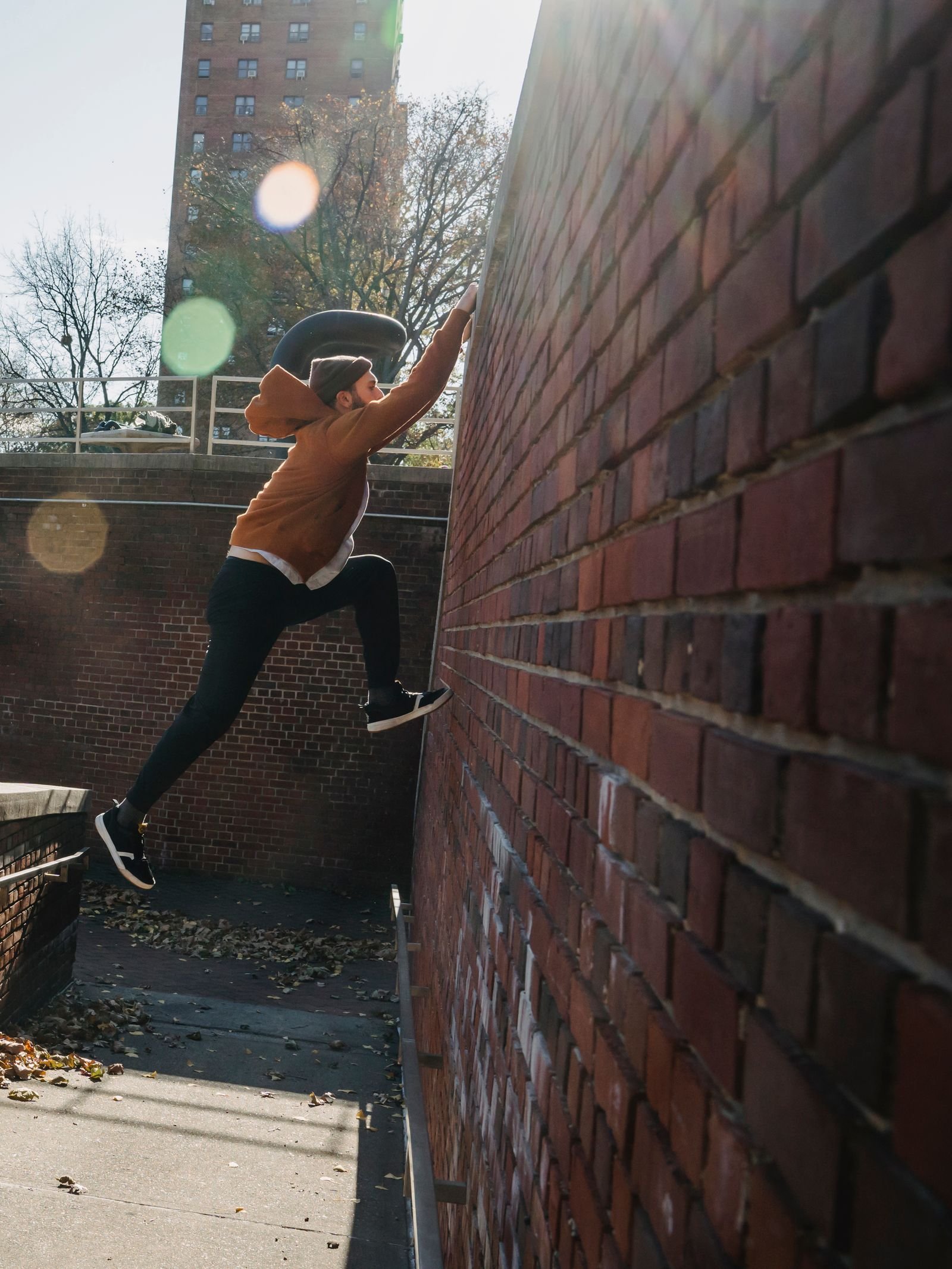
A parkour climb-up gets you from hanging on the edge of a wall to standing on top of it. Grip the edge with both hands, set your feet staggered on the wall, then drive your upper knee into the wall as you pull, swing your lower leg through, press your chest up over the edge with straight arms, and bring your feet up between your hands. It needs real pulling and pressing strength, so build it with pull-ups, wall dips and a “struggle-up” before you go for the clean version.
What You Need First
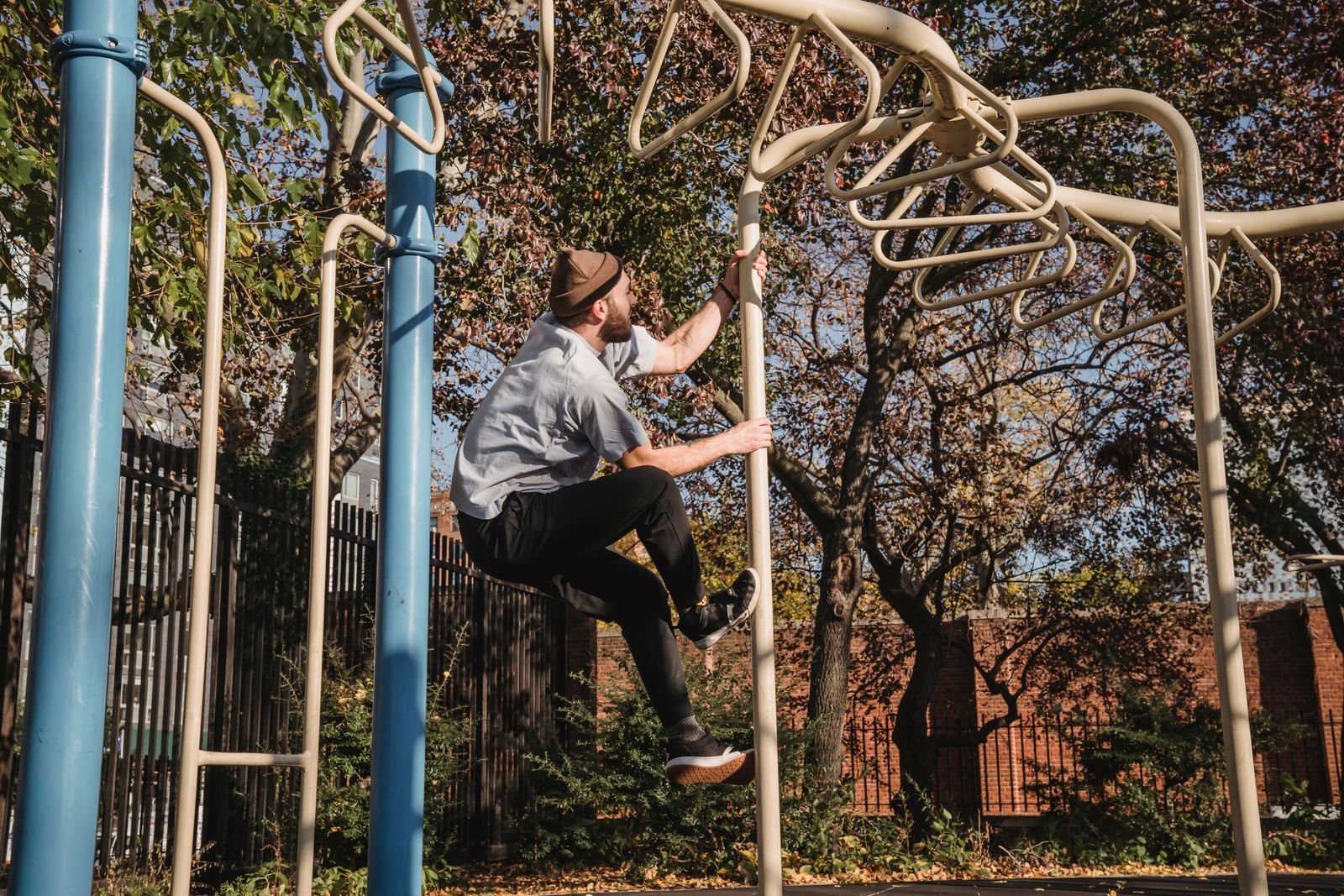
In his climb-up guide for Breaking Muscle, physical therapist and APEX Movement coach Ben Musholt breaks the climb-up into a pull and a press, and lists drills to build both. Strong pull-ups and dips are the foundation, and the drills below build the same strength. Our guides to grip endurance and pull-up bars for parkour cover the pulling side.
How to Do a Climb-Up, Step by Step
This sequence follows Musholt’s breakdown of a climb-up from a dead hang:
- Grip the edge. Both hands on top of the wall, with as much of your palms in contact as you can.
- Hang. Lower until your arms are nearly straight, so your back muscles take the tension.
- Set your feet. Stagger them on the wall: one knee bent up close to your body, the other foot about 18 inches lower.
- Drive and pull. Drive the upper knee into the wall as you pull hard with your arms.
- Swing through. Kick the lower leg back and bring it forward as your chest rises above the wall.
- Press over. Push down through your hands to bring your chest above the edge, arms straightening.
- Feet up and stand. Bring your feet up between your hands, then stand up.
Drills That Build the Climb-Up
- Cat hang pull-ups. Hang from a wall edge with your feet staggered on the wall, and pull your chin above the top. Musholt lists this as a key drill.
- Wall dips. In a separate Breaking Muscle guide, Musholt describes setting up on top of a wall with your hands under your shoulders, lowering your chest towards the wall and pressing back up. He suggests starting with 5 reps and building to sets of 10. This trains the press-over.
- False grip hangs. Musholt recommends hanging with the wrists flexed over the edge to build wrist strength and comfort in the starting position.
- Muscle-up work. American Parkour’s muscle-up training session combines pull-ups, dips, jumping muscle-ups, slow muscle-up negatives and climb-ups on a wall.
Progressions to the Full Climb-Up
- The struggle-up. Get your elbows onto the top, then one knee, then stand. It isn’t pretty, but it gets you over the wall.
- One foot at a time. Press over and place one foot on top, then the other.
- Both feet together. Press over and land both feet between your hands in a squat.
Musholt suggests a benchmark once you can do it cleanly: time five consecutive climb-ups from a dead hang. He says elite athletes can do it in about ten seconds, so don’t worry if you’re nowhere near that.
Adding a Run: The Wall Run Into a Climb-Up
Most real climb-ups start with a run and a kick off the wall, which gets your hands to the top without a dead hang. Research on this backs a measured approach. In a study summarised in the Journal of Experimental Biology, researchers recorded 67 wall climbs by traceurs on a 3 m wall. A computer simulation suggested an intermediate run-up speed was most efficient: too slow and the take-off leg has to work harder, too fast and the leg has to absorb a jolt. Our guide on how to wall run covers the approach.
Train It Safely
- Start on a wall low enough that you can step off safely if your grip goes.
- Check the edge before you trust it. Loose coping, wet stone and sharp edges are all reasons to choose another wall.
- Warm up your wrists and shoulders first. Our warm-up checklist covers both.
- Stop when your grip is tired. A failed climb-up from a tired grip ends with a drop you didn’t plan.
Frequently Asked Questions
What’s the difference between a climb-up and a muscle-up?
They use the same pull-and-press pattern. A muscle-up is usually done on a bar with no help from your feet. A climb-up is done on a wall, where your feet on the wall face help drive you up.
How is a climb-up different from a cat leap?
A cat leap is the jump that gets you hanging on a wall. The climb-up is what you do next to get on top. Our cat leap guide covers the first half.
Where to Go Next
Link it to the move before with The Parkour Cat Leap, and build the run-up with How to Wall Run.