Before you move, you scan for five things: edges, heights, traction, hand support, and landing zones. Look first, then move. That habit is what separates a traceur reading a space from someone running at it and hoping, and it’s trainable in a way that jumping further isn’t.
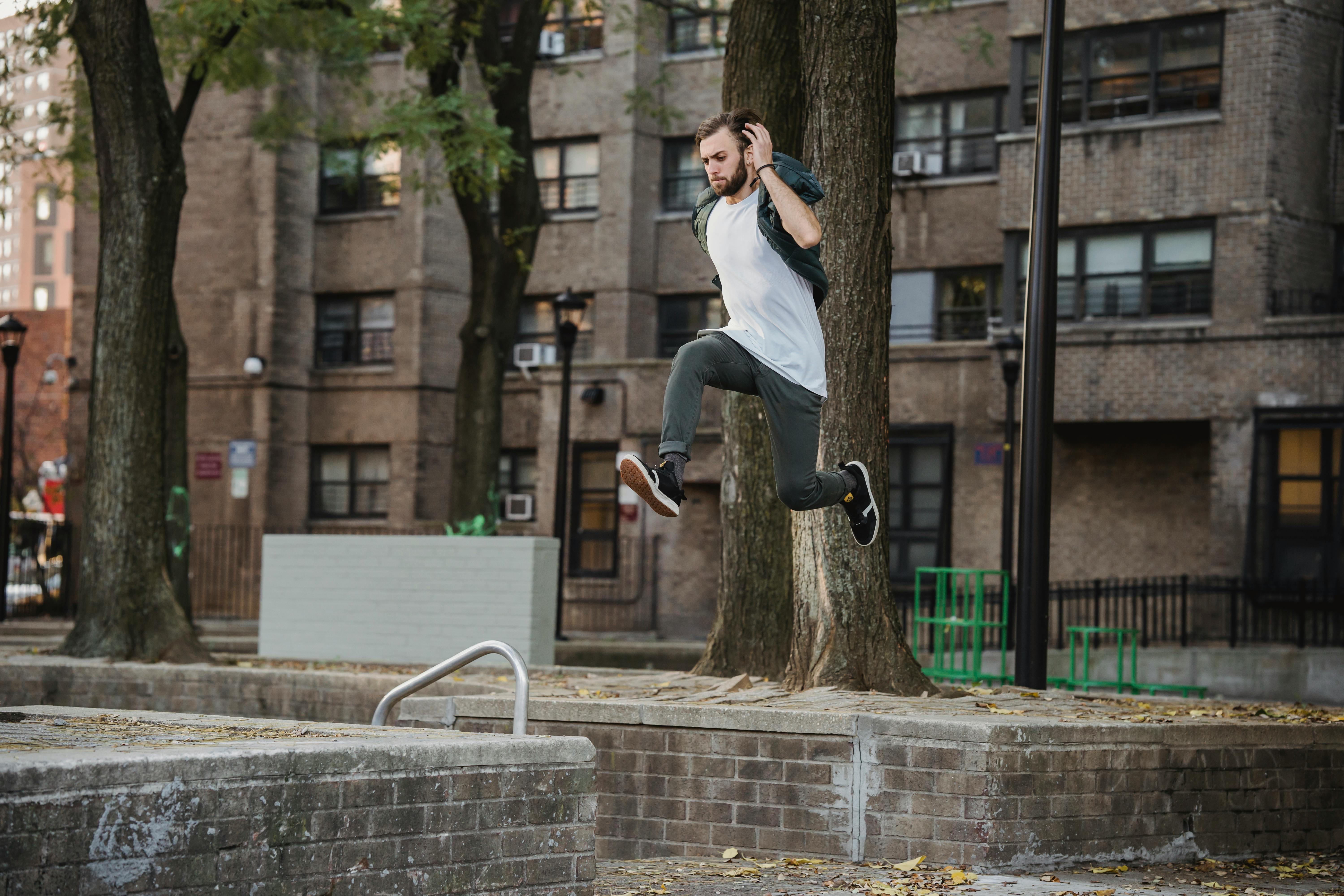
The Five-Point Scan
The framework comes from parkour education, where American Parkour teaches reading the environment as a distinct skill alongside choosing an appropriate challenge and moving with control. The scan looks for:
- Edges. Where does the surface stop? Is the edge square, rounded, chipped, or capped with loose stone?
- Heights. Not just how high, but relative to you, is that rail hip height or chest height, and what’s the drop on the far side?
- Traction. Dusty concrete, wet paint, polished tile, morning condensation on metal. This changes hour to hour.
- Hand support. Where could your hands go if this doesn’t work? A bail plan is part of the read, not an admission of doubt.
- Landing zones. What’s underfoot where you arrive, and is there room to run out or roll?
Test Before You Trust
A visual scan tells you a lot and not everything. Push on the rail. Stand on the ledge. Scuff a foot across the surface. Railings that look solid are sometimes bolted into crumbling mortar, and finding that out mid-vault is expensive in more ways than one, if a railing gives way under you there’s a real chance you’re also liable for the damage.
Choosing a Challenge You Can Actually Meet
Most environments offer several valid routes through, which means difficulty is something you dial rather than something the space imposes. That’s the useful part. Faced with a set of obstacles, you can pick the version that matches today’s ability, today’s fatigue, today’s surface conditions.
The skill is being honest about which version that is. A line you can complete cleanly teaches you more than one you scrape through.
Too Many Options Is Its Own Problem
A spot with endless possibilities sounds ideal and often produces nothing but wandering. If you find yourself drifting between obstacles without committing, deliberately shrink the space. Work one hip-height wall for vaults. Use a curb for precision landings. Take a patch of grass for rolls.
Constraint produces better sessions than abundance does, particularly early on.
Building an Actual Line
A line is a sequence of movements through a space. Plan it before you run it, walk the route first if you need to, and decide each transition in advance rather than improvising mid-flow.
Two things to check as you plan. First, does each movement leave you in a position to start the next one, or are you landing facing the wrong way? Second, where does the line end? A sequence with no planned exit tends to finish with an awkward stop.
The Part That Isn’t About Obstacles
Read the people too. Heavy foot traffic breaks concentration and creates genuine collision risk. Private property creates a different kind of problem. Public spaces with room to move and few pedestrians are worth more than architecturally perfect obstacles you’ll be asked to leave in ten minutes.
Frequently Asked Questions
How long should I spend assessing before moving?
Longer than feels necessary when the movement is new or the surface is unfamiliar, and it gets faster with experience rather than being skipped. Experienced traceurs still scan, they’ve just compressed it into a few seconds.
Does reading the environment matter indoors?
Less, because a gym controls the variables for you. That’s exactly why outdoor training develops the skill better: the surfaces, spacing and conditions are never quite the same twice.
What if a spot looks good but feels wrong?
Take that seriously. Often it’s your read noticing something you haven’t consciously articulated yet, a surface that’s subtly wet, an edge that’s more rounded than it looked. Go back and check specifics rather than overriding the feeling.
Where to Go Next
Reading a space and moving through it are two halves of one skill. Read next: Finding Parkour Spots in Small Towns and How to Chain Parkour Movements Into Smooth Flow.