The goal isn’t to stop being afraid. Fear is doing a job, and traceurs who ignore it get hurt. The goal is to tell the difference between fear that’s protecting you from something real and fear that’s just unfamiliarity, then shrink the movement down until the second kind runs out of things to say.
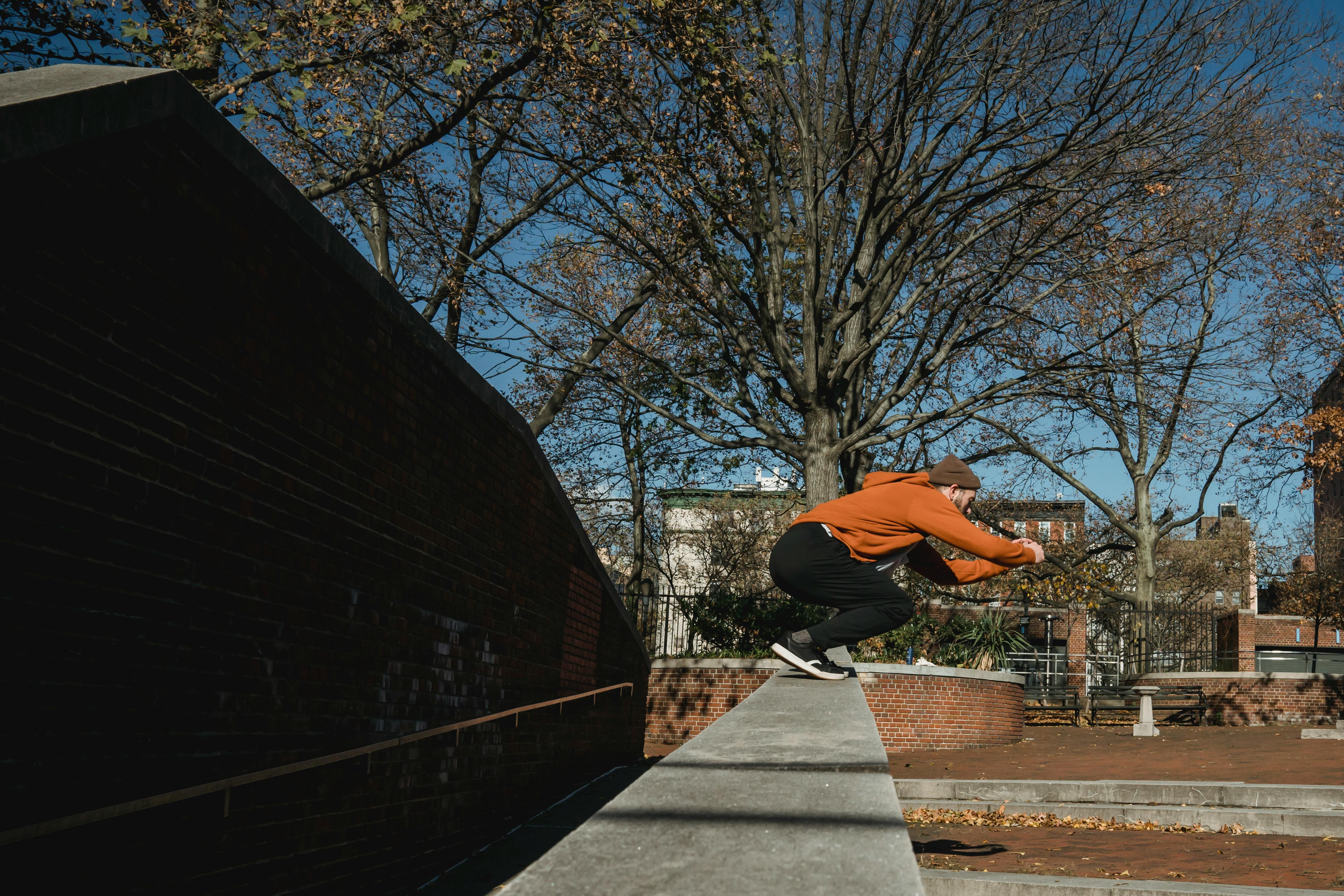
1. Learn to Tell Rational Fear From Irrational Fear
This is the distinction everything else depends on. Rational fear is information: the gap genuinely is beyond what you’ve trained for, the surface is wet, you’re tired and your landings have been sloppy for twenty minutes. That fear should win, and overriding it is how people get hurt.
Irrational fear is different. You’ve made this exact jump forty times at ground level and nothing has changed except that today it’s two feet higher, or people are watching, or you failed it once last month. Experienced traceurs describe this as exposing yourself to risk rather than to danger, and the skill is making a conscious judgement about which one you’re facing instead of letting the feeling decide for you.
A useful question: what specifically would have to go wrong, and what would actually happen if it did? If you can’t answer concretely, you’re probably dealing with the second kind.
2. Scale the Movement Until It Stops Being Scary
This is the single most effective technique in the list. Ben Musholt, a physical therapist and certified parkour coach, describes freezing up over a jump to a wooden pillar six feet away and three feet off the ground, a movement well within his ability. His training partner suggested scaling it: start close enough that the jump is trivial, then work backwards to the full distance in increments.
That’s the whole method. Find the version of the movement you can do without hesitation, then make it fractionally harder. Lower the height, shorten the gap, move to grass, add a spotter. You are not avoiding the movement, you’re arriving at it from a direction your nervous system will accept.

3. Find Out What You’re Actually Afraid Of
Fear usually announces itself with a cover story. “The gap’s too big” often turns out to mean something much more specific: you’ve never landed on a rounded surface before, or you don’t trust your left foot to take off cleanly, or you’re worried about what happens if you come up short and have to bail.
Coaches who work on this describe people offering two or three explanations before the real one surfaces. It’s worth the effort, because the actual fear is usually far more fixable than the stated one. “The gap’s too big” has no obvious solution. “I’ve never landed on a rail” has a very obvious one: go practise landing on a rail, six inches off the ground, until it’s boring.
4. Use Your Breath and Your Eyes
Two physical levers you have in the moment. A slow breathing cycle, in for four, hold for two, out for four, repeated two or three times, measurably settles the shaking-legs response before an attempt. It’s not a trick, it’s just downshifting your nervous system.
The second is where you look. Eyes fixed on the landing point rather than the gap beneath it, and a process cue rather than a fear narrative, something like “eyes on target, drive through the hips, soft knees.” Your body follows your attention, and “don’t fall” is not a usable instruction.
5. Train With Someone Who Can Assess the Risk With You
A coach or experienced training partner does something you can’t do alone: give you an outside read on whether the fear is rational. When someone who knows your ability says “you’ve got this, your take-off is fine, the problem is you’re looking down”, that’s genuinely useful information rather than encouragement. They can also spot you, which changes the actual risk rather than just how you feel about it.
This matters more than it sounds: injury survey data shows injuries are more likely during solo training than group sessions, so the partner is improving your odds as well as your nerve.
How Parkour Builds Confidence
Working through fear this way does more than get you over one jump. An article on Parkour UK’s site explains it in terms of prediction: every jump starts with your brain predicting whether you’ll make it. When you succeed at something you doubted, that prediction gets corrected, and repeated corrections build self-belief. Scaling movements, as in tip 2, is a way of collecting those small wins on purpose.
That’s why traceurs often describe confidence carrying over beyond training. The skill isn’t bravery. It’s the habit of breaking something intimidating into steps you can actually take, and then taking them.
Staying Focused Through a Whole Session
Fear spikes at the moment of commitment, but distraction chips away at you all session, and a half-attentive attempt is where a lot of sloppy landings come from. Three habits help:
- One goal per session. “Clean speed vaults off my left foot” gives your attention somewhere to go. “Train parkour” doesn’t.
- Phone away between attempts. Filming is useful. Scrolling between sets pulls your head out of the movement you’re about to do.
- Pick spots with room to think. Heavy foot traffic breaks concentration and adds collision risk, which is part of reading your environment before you move.
Frequently Asked Questions
Does fear ever go away completely?
No, and it shouldn’t. Experienced traceurs consistently describe fear as permanent and useful. What changes is your ability to read it accurately and act deliberately rather than freezing or overriding it.
I freeze mid-movement. How do I stop?
Freezing partway through is genuinely dangerous, because many movements depend on carrying momentum through to the end. If you’re hesitating mid-attempt, the movement is above your current level. Scale it down rather than trying to force commitment.
Is being afraid a sign I should quit?
No. It’s a sign your risk assessment is working. What matters is whether you can scale movements down to a level you can do calmly and build up from there. If fear is affecting you well beyond training, that’s worth talking through with someone qualified.
Where to Go Next
Confidence comes from competence. Read next: How to Start Parkour Safely and How to Progress From Beginner to Intermediate Safely.
Pingback: Breathing Techniques For Sustained Parkour Sessions - ParkourChase