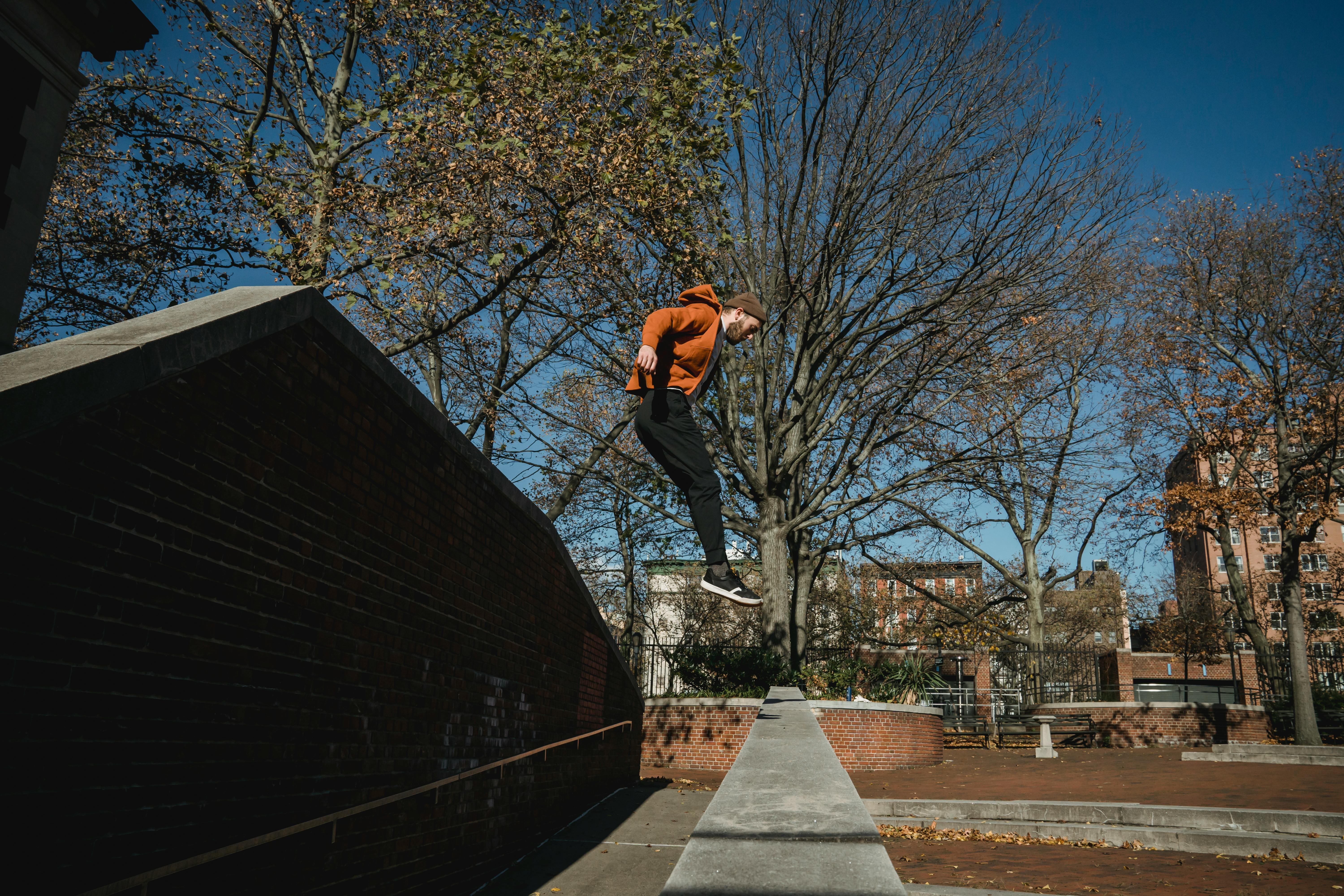
A tic tac is a single step off a vertical surface used to redirect your momentum sideways or upward, rather than to climb. That’s the whole distinction from a wall run: a wall run takes you up a wall, a tic tac takes you across it and off toward somewhere else. It’s what lets you treat a wall like a floor you can push off.
Choosing a Wall
Not every surface works. Coaching guidance from parkour instructors at Team JIYO sets two clear criteria: the wall should be genuinely non-slip, and it should be above your chest height. A low wall doesn’t give you anywhere useful to plant, and a slick painted surface turns the push-off into a slide. Solid brick is the standard learning surface for good reason.
Approach at an Angle, Not Head-On
Run at the wall on a diagonal, roughly 30 to 60 degrees. A head-on approach gives you nothing to redirect, you just stop. The angle is what lets your momentum carry through the wall contact and out the other side in an arc. Take off about a metre to a metre and a half out, pushing from your outside leg so your inside foot is the one that meets the wall.
Lean Away, Then Close In
As you plant your foot, your body leans away from the wall, then you bring your chest toward it as you push off forward and upward. Same principle as the wall run: contact away, then close the gap. If you arrive already leaning into the wall, there’s nothing left to push against.
Foot Height Decides Lift Versus Distance
This is the adjustable part of the movement. Plant higher on the wall and you get more lift but less horizontal distance. Plant lower and you get more distance but less height. Neither is correct in the abstract, it depends entirely on whether you’re clearing something tall or crossing something wide. Expect to experiment to find your own optimal placement.

Sight Your Landing Mid-Push
As you leave the wall, turn your head and body toward where you’re going. Your body follows your eyes here more obviously than in almost any other parkour movement. Then land using whatever suits the situation, a precision, a roll, a cat, or simply running out.
Two Mistakes Worth Naming
Spanning is reaching your hands to the target before your feet have left the wall. It feels like reassurance and it costs you the entire benefit of the movement, you end up stretched between two surfaces with no lift and no control.
Aiming straight at the target rather than arcing upward means you arrive flat and fast, which increases the force of the impact. A tic tac with genuine lift gives you a softer landing and more time to adjust in the air.
Landing Without Getting Spun
A tic tac carries sideways momentum, so a flat two-footed landing tends to twist you. Put your outside leg out slightly and land on it first, then bring the other down. That sequence bleeds off the rotation instead of fighting it.
Frequently Asked Questions
Should I learn the tic tac before the wall run?
Generally yes. The tic tac teaches you how a foot behaves against a vertical surface and how to convert momentum, at lower height and lower consequence than a full wall run. It’s commonly recommended as the earlier skill.
Can I tic tac off things other than walls?
Yes, rails, posts, bollards, and similar street furniture all work, provided they’re solid enough to take your weight and have usable grip. That versatility is a large part of why the movement is worth learning.
Do I need to train both sides?
Yes. Real obstacles won’t accommodate your preferred leg, and a tic tac you can only do off one side is a skill you’ll frequently be unable to use. There shouldn’t be a bad side.
Where to Go Next
The tic tac feeds directly into wall skills and explosive power work. Read next: How to Wall Run and Plyometrics for Parkour.